
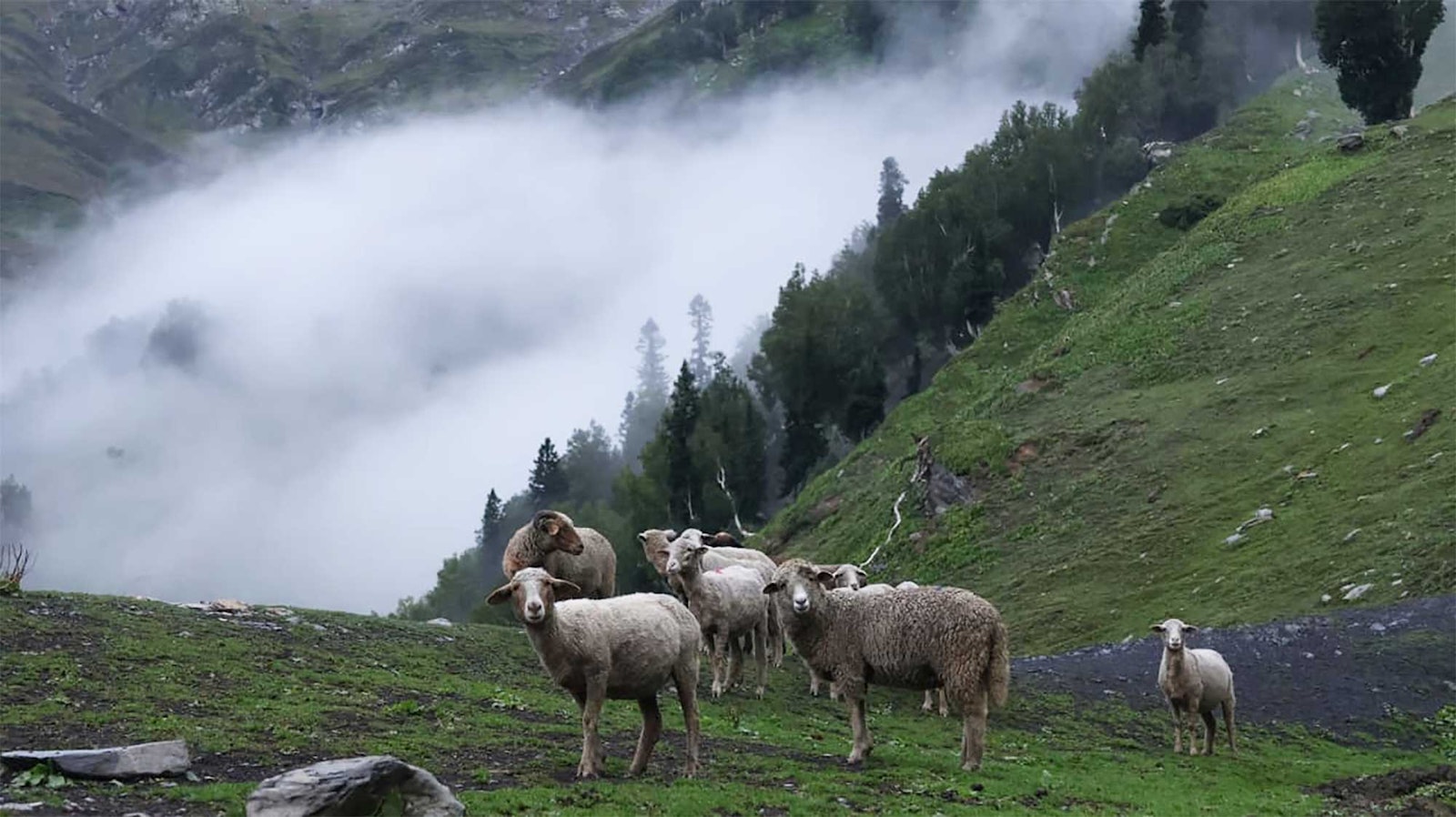
Shepherds often face an uphill battle in selling their sheeps’s wool at a profit. The Desi Oon initiative works to assist sheep herding communities and wool artisans in enhancing wool’s profitibility. Writing on the initiative brought me in touch with a lot of organizations, little companies, and social enterprises which are working to keep the pastoral community and their flocks of indigenous sheep alive. One such is the Bakarwal community, a little-known nomadic pastoral group primarily located in the Jammu, Kashmir, and Ladakh regions of India.
Desi Oon organizes a little festival or bazaar every year around the 10th of December. Many people come and sell their products. It was at Desi Oon that I met Mr. Faisal Raza Bokda, who started Bakarwal Crafts in a bid to preserve the cultural history and heritage of his community.
Faisal says, “when I first visited Desi Oon, I saw how others were exhibiting their traditional crafts and indigenous wool. I realized that the Bakarwal sheep, Bakarwal goat and of course the Bakarwal dog were conspicuous by their absence.” The Bakarwal community is known for its particular breed of sheep and goats which is referred to as Bakarwali sheep and Bakarwali goats. Faisal says, in their spoken language, Gojri, it is “bhed for sheep and Pahari bakr for goats.”
 Faisal poses in front of smaller shawls, worn by Bakarwal men. Photos by Chitra Balasubramaniam unless otherwise noted.
Bakarwal Sheep and Goats
Speaking of the community Faisal says, “we are basically nomads and spend six months of Winter in the plains of Jammu. In the remaining six months of the summer we move to Kashmir.” Faisal’s family is settled in the Samba District in the Indian State of Jammu. He adds, “we are not totally nomadic. I have 20–30 goats. I give [the herd] to shepherds who take it higher altitudes for grazing. They take it and bring them back to me to look after during the winter months.”
The Bakarwal goat is beautiful! The goat has long hair which is sheared—otherwise it gets stuck in branches in the forest. Speaking of sheep rearing, Faisal says, “ten years ago, individuals had huge herds of sheep. It used to easily number 1,000–1,200 Sometimes even going up to 1,500. Today, it has come down to around 200–300. The maximum going up to 500 sheep.”
 Bakarwal goats being herbed by a shepherd. Image courtesy of Faisal Raza Bokada—Bakarwal Crafts
Beginning of Bakarwal Crafts
The Bakarwal Craft initiative began three or four years ago. Faisal says, “I dd not have any direction or plan in mind. Just like all the others were trying to preserve their tradition and craft, we should also do it.”
When he started researching, he discovered that old practices and customs were being forgotten. He adds, “a lot of handmade things were made using sheep wool. We used to make a lot of products for personal use. Now, nobody wants to make it. Alternate products from the market are easily available. They are cheaper and attractive.”
Shearing
The Bakarwal sheep is reared for mutton, the goat for its milk. The wool today has become a nonentity with little value to it—a paltry 10–12 rupees per kilogram, or less than six cents a pound in US weights and measures. The wool is shared at high altitudes and simply thrown away in the hills, since the cost of bringing it down is more than price shepherds can get for the wool.
“Shearing is a necessity, it is done and wool is left behind. Faisal says, “I made a documentary. I travelled to the high altitudes last year and have photos of meadows simply covered with wool.” Faisal received the Royal Enfield green hub fellowship to document the life and tradition of the community.
 Bakarwal sheep. Faisal Raza Bokada–Bakarwal Crafts
Carding and Spinning Bakarwal Wool
Faisal explains, “earlier in our village every woman spun wool using the Gandhi charkha. Today, no one does it.” He remembers every family had its own herd of sheep. After the shearing, there used to be a celebration in every home. All the women would go to one house with their charkhas and spin the family’s entire clip of wool. Then they went on to the next family’s home. No money was given or taken—it was a community affair. The women would have great fun, spinning, talking, laughing, and singing. The house where they had congregated for spinning would organize a sumptuous lunch and provide warm drinks throughout the day.
Women card, clean, and spin the wool. The weaving is not done in the community. The spun yarn is given to Jammu weavers in the plains who weave a large, warm traditional blanket that gives excellent protection against the cold. A smaller shawl is woven which is used by the men. It is exceptionally warm and good against rain.
When the cloth becomes old or unusable, women used to cut them into small squares and embroider them all over. These small squares were joined to make carpets for the floor or were spread out when guests came to the home. Bakarwal women are skilled in wool embroidery. Traditionally, the wool was handspun and naturally dyed. Now acrylic yarn is used for embroidery.
 Embroidery done on worn out blankets using naturally-dyed yarn.
Bringing Back the Craft
With no one weaving or spinning, Faisal had an uphill task of trying to put together a team. His sister is well versed in embroidery. She and grandmother started working. Faisal also realized embroidery can generate employment and income. Now he has a team of 10 people, including his mother, wife and sister, and seven other people from the village.
Today, Faisal is buying pure handspun yarn dyed using natural colors from Kullvi Whims, social enterprise based in Himachal Pradesh in India. Kullvi Whims supports Bakarwal crafts by selling jackets that are woven by Kullvi Whims and embroidered by Faisal’s team.
 A jacket woven by Kullvi Whims and embroidered by Bakarwal Crafts.
The focus is on honing embroidery skills using wool. In addition to the jackets, the team is experimenting with small items for the market, such as bags and coasters.
Faisal has a lot of plans, including “to start a natural dyeing unit. Revive spinning on the charkha in the village. Offer better rates to the shepherds so that the wool is not wasted, make more blankets.” Getting a designer to help them make new products is an option Faisal is exploring. It is also a wonderful way of upcycling old woolen products. It is a brave bold attempt to preserve the tradition of Bakarwal crafts and their pastoral wealth.
Resources
Learn more about Desi Oon here. Find Bakarwal Crafts on Instagram @bakarwalcrafts.
Originally published April 15, 2026, updated May 4, 2026.