
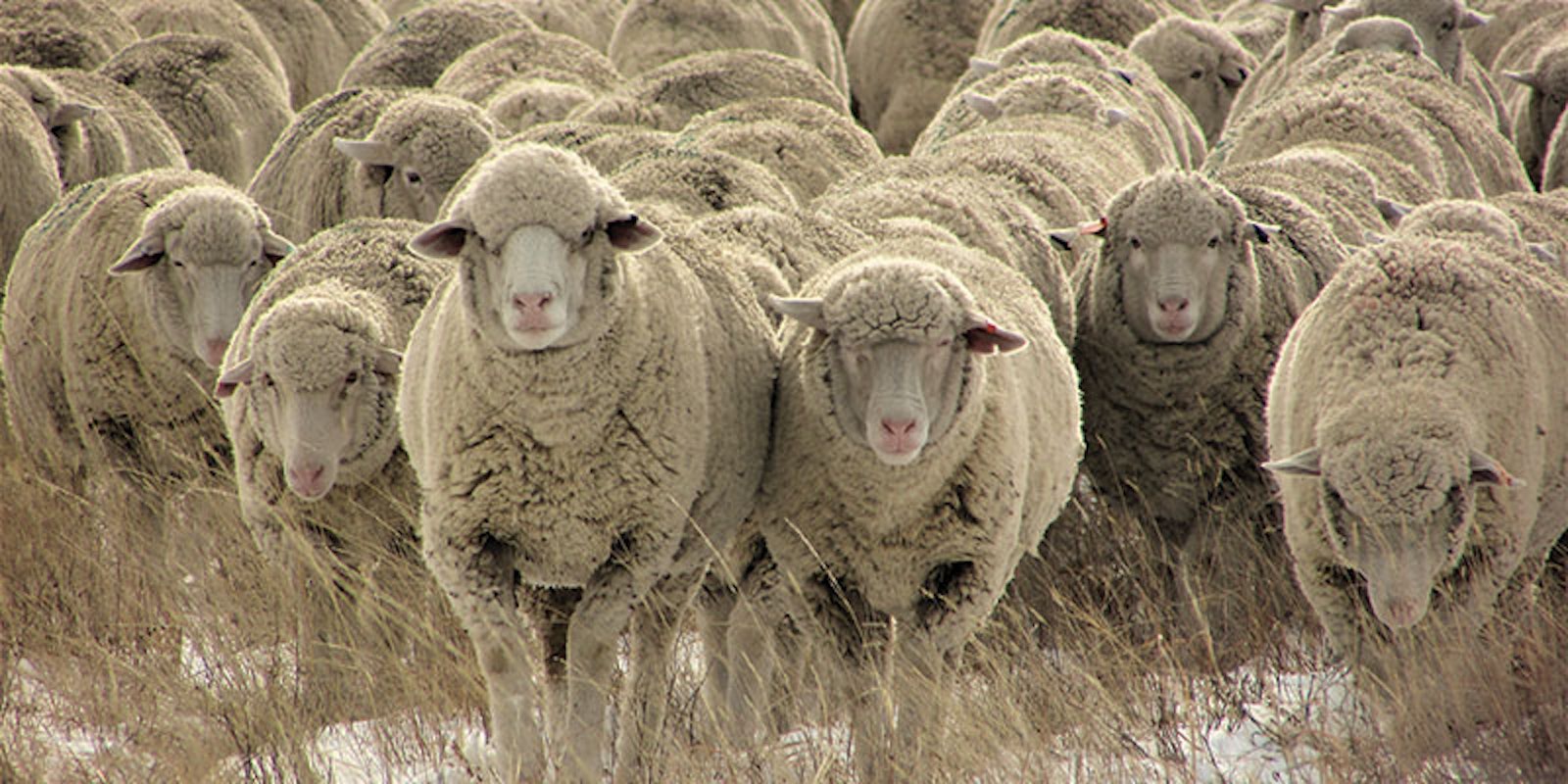
You might have heard of Targhee sheep, and even spun their wool, but did you know they’re a relatively new breed, developed in the United States 100 years ago? Read on to learn about this breed and their wool.
—Spin Off editors
What is Targhee and Why Should I Spin It?
Adapted from “Targhee for Knitters and Weavers” by Maggie Casey
Targhee sheep were developed at the Sheep Experiment Station in Dubois, Idaho, in 1926. The plan was to create a dual-purpose sheep that could handle the climate of the cold, arid west, and produce high quality wool as well as meat. Rambouillet rams were bred with Lincoln/Rambouillet or Corriedale ewes and the lambs were then backcrossed. The Rambouillet side of the cross provided a fine, crimpy wool but with a shorter staple length, while the Lincoln/Rambouillet and Corriedales provided length and strength. Depending on who you reference, Targhee is classed as either a fine or medium wool. The staple length of fiber is 3–5 inches (I haven’t found any Targhee with a 5-inch staple, but I’m still looking). The micron count is in the 21–25 range. Targhees are named for the forest they grazed on and that forest is named for Chief Targhee, a member of the Bannock Tribe.
Years ago I knit a Targhee vest that is still one of my favorites. At the time, it was quite an ambitious project since it was two-color knitting in the round and involved cutting steeks—all things I had never done. But I had fallen in love with some dyed Targhee braids that had just arrived in the yarn shop that I co-owned at the time, so I spun some yarn, made a gauge swatch, and started knitting the Four Corner Vest, by Cheryl Oberle. The spinning and knitting gods must have been very kind to me back then, because I finished the vest without any problems. Years later, that vest still looks great. It hasn’t pilled or stretched out of shape, it drapes just as it should, and the steeks are as strong today as when I did them.
 Maggie's knitted vest demonstrates how well Targhee wears over time. Photo by Maggie Casey
A Unique Fleece
Adapted from “Targhee: A Resilient Western Wool” by Madeline Keller-King
Eastern Montana and the Great Plains can be a harsh environment, and this landscape was one of the things considered in the early twentieth century by the folks at the US Department of Agriculture (USDA) Sheep Experiment Station in Idaho as they developed what would later be named the Targhee sheep breed. (To learn more about the USDA station in Dubois, Idaho, and the sheep breeds developed there, see Spin Off, Winter 2018.)
The Targhee breed was developed to meet commercial demands, so most fleeces are white, although I have heard of the occasional colored Targhee. And the wool! The stuff is soft, having an almost cottony feel when clean and carded, and it has a matte finish.
This unique fleece brings with it the possibilities of endless comfy garments and accessories. Targhee has an unusual balance of crimp and elasticity with delicious warmth and softness—an inspiring combination.
 At left: Targhee fleece is soft and durable with a lively crimp; photo courtesy of Kami Noyes of Ranching Tradition Fiber. At right: Madeline Keller-King's exploration of Targhee resulted in a chain-plied yarn and a cable-knit swatch; photo by Matt Graves
Plenty to Spin—and to Share!
Targhee sheep grow big fleeces. Mature Targhee ewe fleeces average 10 to 12 pounds of raw wool each year. The wool is remarkably consistent across each fleece—one of the standards of the breed. After scouring, the clean fleeces typically weigh 5 to 6 pounds. That’s more than enough to keep you spinning for a while—or split with some of your spinning friends!
Resources
- Robson, Deborah and Carol Ekarius. The Fleece and Fiber Sourcebook: More Than 200 Fibers, from Animal to Spun Yarn. North Adams, Massachusetts: Storey Press, 2011.
- Find project inspiration for your Targhee fibers in “Targhee for Knitters and Weavers” by Maggie Casey
- Read Madeline’s full article in Spin Off Winter 2023.
- Discover more about the United States Sheep Experiment Station in Spin Off Winter 2018
Originally published July 22, 2026; updated August 8, 2026.