
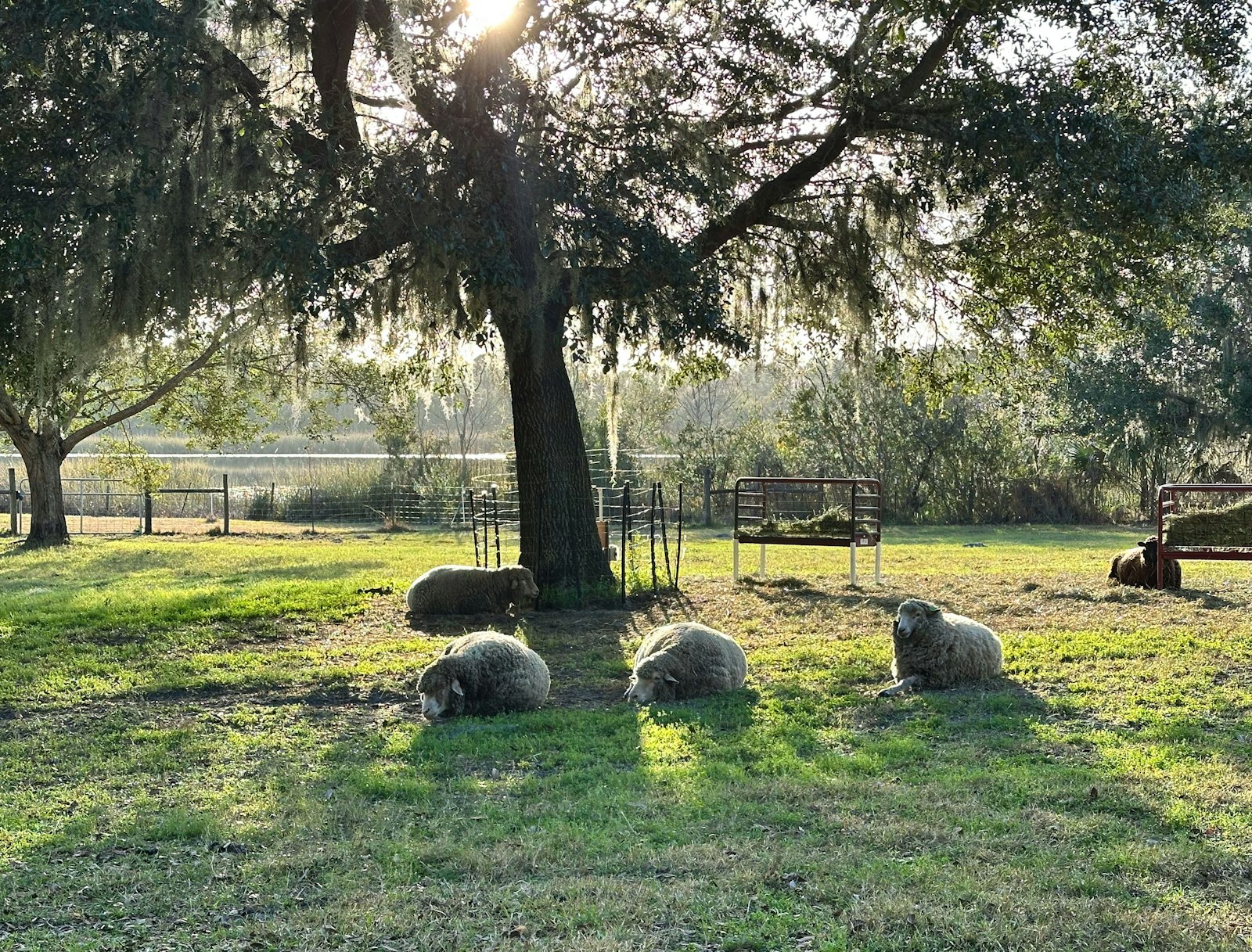
In Spin Off Fall 2026, Sarah Nielsen Baer and Erika Zambello explore the joys of Gulf Coast Native wool. What’s so special about this breed, and why are we hearing about it so much now? Read on to discover some of the exciting ways spinners and shepherds are working with this heritage breed.
—Spin Off editors
Working with Gulf Coast Native Wool
Aleatha Shannon tells us more about the qualities of Gulf Coast Native wool and what she enjoys in the fiber as a handspinner. Adapted from her Meet the Sheep article.
As a handspinner in Louisiana, I was naturally drawn to this local breed. Gulf Coast wool ranges from fine to medium, typically 26 to 32 microns. Staple length is typically 2.5 to 4 inches. Like many heritage breeds, fleece quality varies. Some fleeces have lovely open locks that are a joy to process, while others are a little tippier and take more work. But we have to give the sheep credit for growing wool in hurricane country!
 A freshly shorn Gulf Coast fleece. Photo by Aleatha Shannon
Gulf Coast wool has a lively, squishy character that makes great yarn. I’ve spun it on its own, blended it with angora from my rabbits, and most recently with homegrown cotton. This wool also dyes and felts beautifully.
Working with Gulf Coast wool is emotionally rewarding for history lovers. As I spin, I often imagine Southern homesteaders raising wool and cotton to clothe their families. These sheep have been quietly contributing to the region’s food and fiber systems long before modern agriculture.
From Citrus To Sheep
The Farm & Fiber Knits team got to meet the sheep on location at Florino Farms. Adapted from “Finding Sheep in the Sunshine State”.
About an hour from Orlando and the resorts for which the area is well known lies a sun-dappled farm on the edge of a small lake. Here, at Florino Farms, Jim and Imke Casey are working to create a flock of sheep that will not only survive the extremes of summer heat but also thrive in it, all while growing beautiful finewool.
Realizing their dream of sustainable farming practices and ethical wool production was not without challenges. The land was in terrible shape, and they worked with the county extension agents to make a plan for rehabilitating the soil and replanting. As the farm became established, the couple’s cattle, donkeys, pigs, and ducks were out in the pastures, and soil health improved.
When Imke was ready to start looking for sheep, wool quality was an important focus. “I knew I wanted to raise sheep that produced wool I wanted to knit with,” she shared. “There are several breeds of sheep well adapted to Florida’s climate, but the Merino I was drawn to as a knitter was not one of them.” However, she became curious about creating a crossbred sheep that might be healthy and comfortable in humid Florida and also grow a finewool fleece.
 Gulf Coast Native sheep produce a finewool fleece and are acclimated to the high temperatures of the region.
Imke connected with sheep associations and shepherds, and she began educating herself from the ground up. She connected with Bridget Kavanagh, an experienced Merino shepherd in Michigan, who provided invaluable mentorship and support. She also began learning about a rare sheep that has become adapted to Florida’s intense heat and humidity, as well as the parasites that abound in those conditions: the Gulf Coast Native.
Listed by the Livestock Conservancy as a breed with “critical” status, these special sheep are the descendants of flocks brought to what we now know as the United States by the Spanish beginning in the sixteenth century. The sheep that survived the harsh conditions were hardy and needed little care from shepherds. The Livestock Conservancy notes, “These sheep fit their challenging environment so well that for centuries, they were the only sheep to be found in the deep South, providing wool and meat for home production.” Modern veterinary care allowed more productive yet less adapted breeds to survive in the region, and the Gulf Coast Native population declined.
At Florino Farms, Imke and Jim have crossed Merino and the Gulf Coast Native to create a breed they call "Florinos". According to their website,
This unique blend of Merino and Gulf Coast Native sheep was carefully developed to combine the exceptional fiber quality of Merino with the resilience needed to thrive in Florida’s warm climate. The result is a flock that produces wool with the fine, soft texture characteristic of Merino, but with the durability and adaptability that allows them to flourish under our region’s hot sun and humid conditions.
Lucky for the sheep, the Florinos have retained the heat resistant nature of the Gulf Coast Native breed and enjoy their days on the farm out in the sun!
Resources
- Florino Farms, florinofarms.com.
- Gulf Coast Native Breeders Association, gulfcoastsheep.info.
- Make sure you’re subscribed so you don’t miss out on anything from Spin Off Fall 2026!