
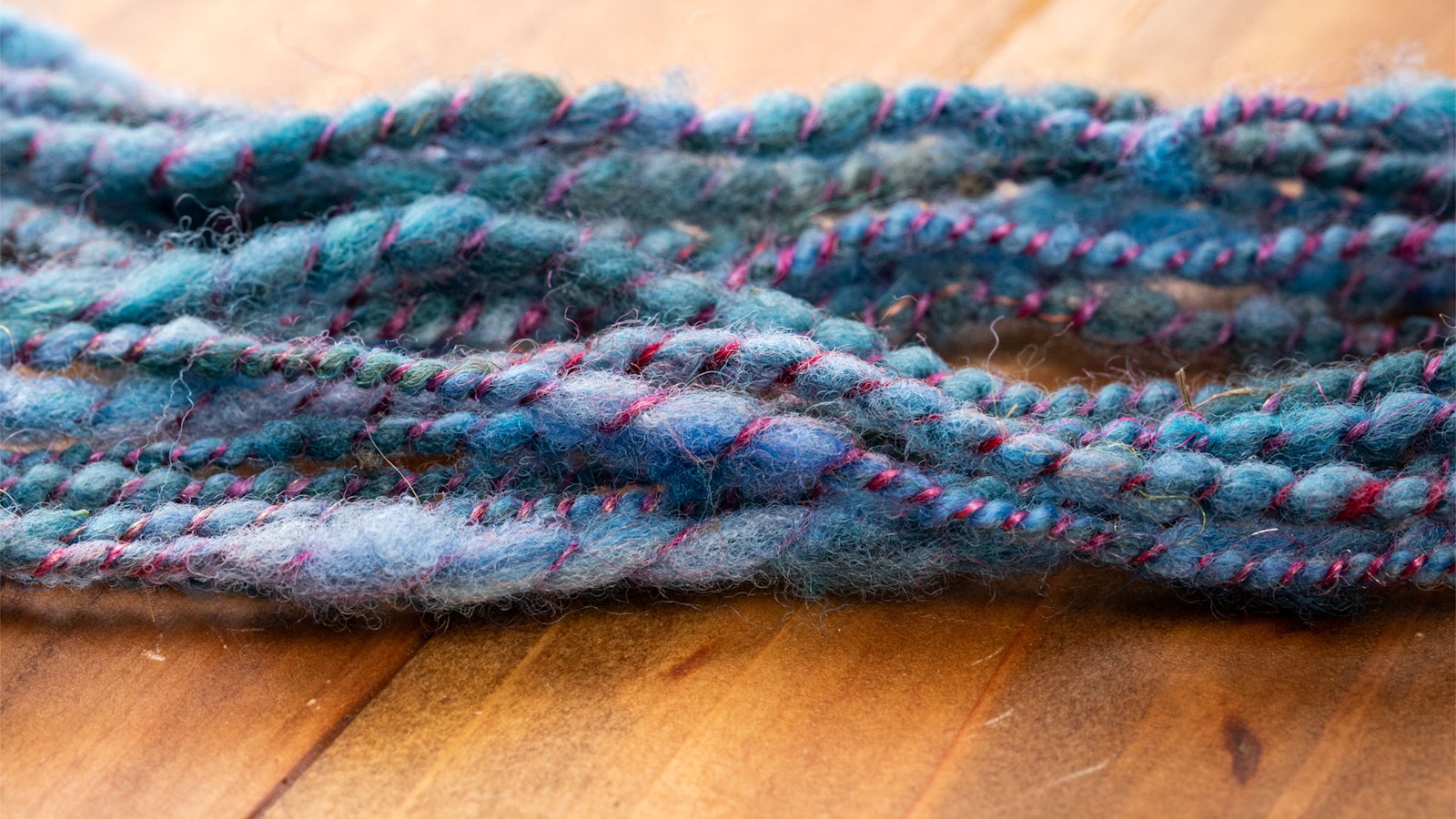
Some spinners measure the success of their spins by the amount of singles remaining on their bobbin after plying, with “none” being the biggest win. I am not that spinner. I celebrate my leftover singles—both wheel and spindle spun—for the plying opportunities they invariably inspire.
Gathering and Perparing Leftover Singles
Any gauge may be used when plying with scrap singles, but my preference is a smooth, fine strand. While most fibers are suitable, I love silks, silk blends, and other denser-spun “shinies”—blends containing Tencel, bamboo, and longer-stapled wools. These are pure magic when paired with a thicker or fluffier singles yarn, highlighting the dichotomy between the light-catching smoothness of my scrap singles against the deliberately thicker new singles.
If the leftovers are on a typical suspended or supported spindle shaft, I wind them off around a quarter-sized cardboard disc for storage and later plying. This makes for compact visibility in a clear container, and I can ply directly from here when I use the yarn. If the singles are on a cross-armed or Turkish spindle, I remove the cop and add it into the container as-is. Since I usually rewind my singles before plying, sometimes they’re already wound around a weaving/storage bobbin, which I store with others like it in a clear plastic shoebox.
 Just a few of Debbie’s leftover singles, ready for plying practice. Note the variety of options in how the singles are stored for plying. Photo by Debbie Held
Plying itself is easy since I’m working with a few yards of very well-rested yarn at a time. I’ll either pop my temporary bobbin on a lazy kate or work with my singles as they are, placing the disc or cop in a bowl on the floor or even just in my lap. I make sure to have extra singles ready before I begin to ply. When I run out of one strand, I’ll add on the next for a truly one-of-a-kind yarn.
 The cop from a cross-armed spindle is a convenient plying package.
Spiral Plying & My Go-To Variations
My go-to ply structure when working with scrap singles is the family of spiral plies.
This ply structure is deceptively simple. To prepare your wheel, slow it down a bit by changing to a larger whorl (if using a treadle wheel) and increasing the tension slightly for a faster take-up. I use my sleekest leftover singles for this one. When I run out of one length, I’m able to lock down the next via a decorative and functional angle change while plying it to my thicker singles.
Here’s How: Once your plies are connected to your leader, hold the finer strand in your front hand (the one that's closer to the wheel) at roughly 45 degrees to the wheel. Hold the fatter singles in your back hand as usual. Slowly begin to ply, creating a spiral as you do.
 A 45-degree spiral ply. Photo by Pamela K. Schultz
For a different look, change the angle of that front hand to 90 degrees (perpendicular to the wheel) to yield a more linear-looking ply.
 A 90-degree spiral ply. Photo by Pamela K. Schultz
Experiment with your angles and tensioning depth using your working hand and strand. These manipulations impact not just the look of the yarn but also the amount of twist in the plying!
Want a whole different perspective? Swap out the singles so the sleek strand is in the typical lap or back-hand position, and the thicker singles is now doing the spiraling.
 A variation on the 90-degree spiral ply, where the thicker yarn is spiraling around the thinner one. Photo by Pamela K. Schultz
All these variations may be applied to corespun, lockspun, and tailspun yarns, too, which have a tendency to be overly energized in one direction. Adding a spiral ply not only helps to polish the finished look of the yarn, it helps balance out that extra twist.
Try a Simple Leftover Skein
If you’re more of a conventionalist, a traditionally tensioned two- or three-ply might be more your thing. This, too, may be accomplished using leftover singles of all kinds, whether of similar gauge and fiber makeup or not.
 Contributing editor Kate Larson made this gorgeous three-ply scrap skein with her leftover singles. Photo by Kate Larson
Conclusion
Have no shame in your leftover singles. Instead, let them be your plying muse for growth, creativity, and added spinning experience. Now that’s a win!
Resources
- Plying Help! 4 Ways to Splice Your Singles
- Find another way to use leftovers with the Equinox Cowl