Subscriber Exclusive
Matching Your Combs to Your Fiber
If your goal is perfectly aligned fibers for worsted spinning, combs have no equal. But how you select your combs and fiber matters, too.
If your goal is perfectly aligned fibers for worsted spinning, combs have no equal. But how you select your combs and fiber matters, too. <a href="https://spinoffmagazine.com/matching-your-combs-to-your-fiber/">Continue reading.</a>
https://spinoffmagazine.com/cdn-cgi/image/format=auto/https://www.datocms-assets.com/75073/1780352438-graves-wool-combs.jpg?auto=format&w=900
Contents
Last fall, author, spinner, and teacher Heavenly Bresser filmed a great combing course that she developed to help you build your wool combing skills. We can’t wait to share that course with you—it’s coming soon—but in the meantime, enjoy this great article about why you should make sure to match your combs to your fiber.
—Spin Off editors
Handspinners use wool combs for specific tasks that no other fiber processing tool can perform. When the goal is perfectly aligned fibers, wool combs have no equal. Although many tools are available for fiber preparation, combs are the best choice for producing a smooth, consistent top. The effectiveness of combing, however, depends on more than the tool alone.
Successful fiber processing relies on both proper technique and appropriate fiber selection. Understanding how to pair fibers with a set of hand combs is essential for learning how to use the tool safely and effectively. Sharp tines combined with unsuitable fibers can lead to wasted fiber, frustration, damaged tools, and even injury, making thoughtful fiber choice critical. Selecting suitable fibers ensures safer combing and higher quality results. Before choosing fiber, it is important to consider the combs themselves. No single comb is appropriate for all fiber types.
SUBSCRIBER EXCLUSIVE
Last fall, author, spinner, and teacher Heavenly Bresser filmed a great combing course that she developed to help you build your wool combing skills. We can’t wait to share that course with you—it’s coming soon—but in the meantime, enjoy this great article about why you should make sure to match your combs to your fiber.
—Spin Off editors
Handspinners use wool combs for specific tasks that no other fiber processing tool can perform. When the goal is perfectly aligned fibers, wool combs have no equal. Although many tools are available for fiber preparation, combs are the best choice for producing a smooth, consistent top. The effectiveness of combing, however, depends on more than the tool alone.
Successful fiber processing relies on both proper technique and appropriate fiber selection. Understanding how to pair fibers with a set of hand combs is essential for learning how to use the tool safely and effectively. Sharp tines combined with unsuitable fibers can lead to wasted fiber, frustration, damaged tools, and even injury, making thoughtful fiber choice critical. Selecting suitable fibers ensures safer combing and higher quality results. Before choosing fiber, it is important to consider the combs themselves. No single comb is appropriate for all fiber types. [PAYWALL]
 Always start with clean fleece! The fleece on the left has not been scoured yet. The fleece on the right is ready to comb. Photos by Heavenly Bresser unless otherwise noted
What Kind of Combs Do You Have?
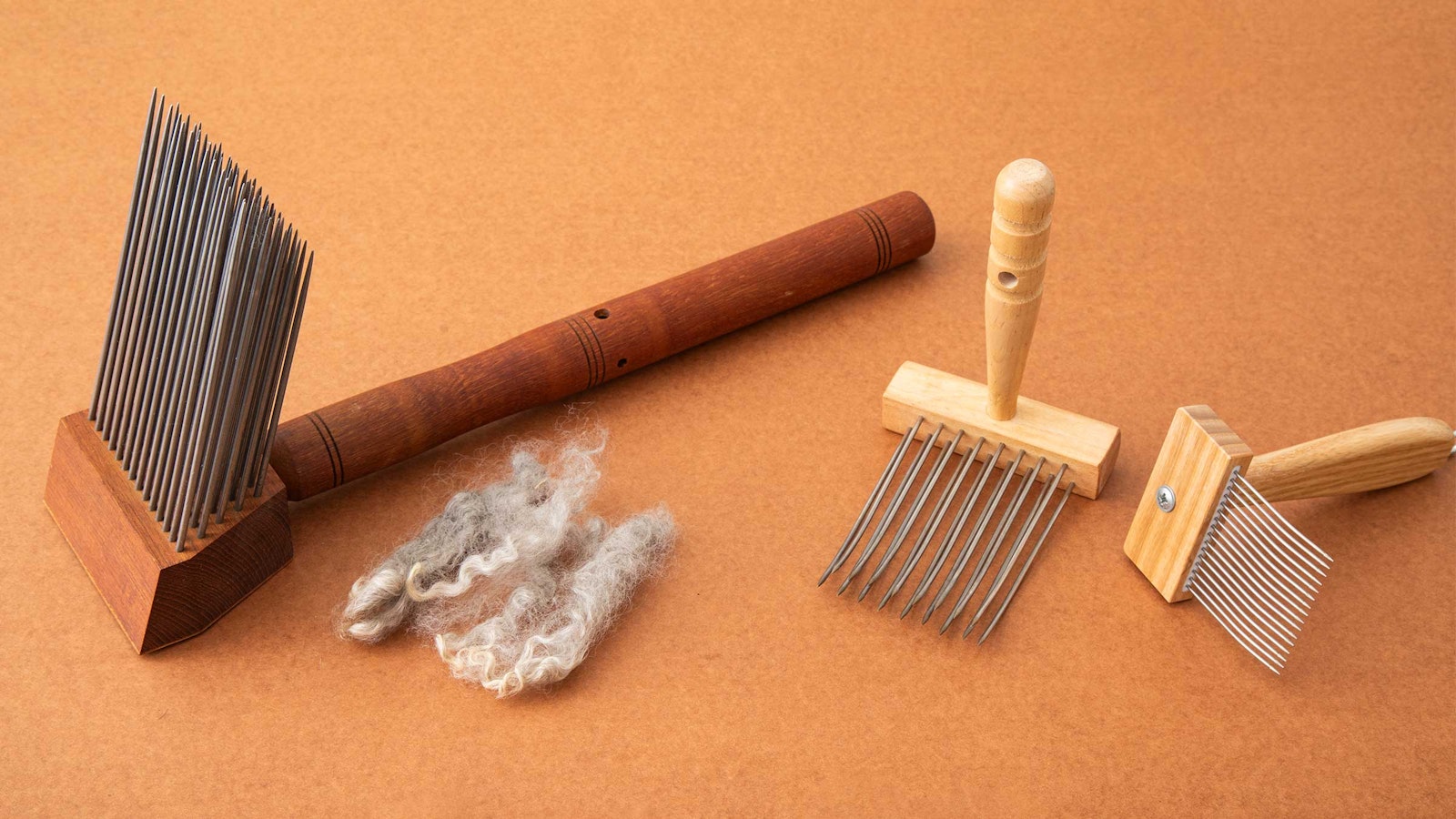
All wool combs are designed with a handle, a head, and sharp metal tines. There are many styles of combs, but the two most common are Viking-style and English-style combs. Viking-style combs feature one or two rows of tines, while English-style combs may have as many as six. Some wool combs on the market are labeled Fine, Extra Fine, and Super Fine based on tine spacing from 1/4" to 1/8" as well as tine thickness.
 Double Row Viking comb, Valkyrie (left). 6-Pitch English comb, Indigo Hound (right).
Tine Thickness and Spacing
The spacing between the tines plays an important role in fiber selection. Wider spacing is better suited to coarser, higher-micron fibers, while closely spaced tines make finer, lower micron fibers easier to comb. Tine thickness is another key factor. Thicker tines provide the rigidity needed to hold and transfer heavier locks, making them better suited to coarser fibers, while thinner tines work more effectively with finer fleeces and lower-micron fibers. When fiber is too coarse for a particular set of combs, excessive resistance and visible stress on the tines are common indicators. Conversely, fibers that are too fine may fail to load properly, slipping between the tines and off the combs during use.
 Double row combs. These Valkyrie combs have tines with ¼" spacing.
Staple Length Considerations
Understanding the characteristics of wool combs helps narrow fiber choices for fine, medium, or coarse fibers—but what about staple length? A minimum staple length of three inches is ideal for most wool combs because it allows the fiber to rest on the row(s) of tines with enough room in front for combing. While fibers with a two-inch staple and shorter can be combed, they require greater care when loading and often result in a more cumbersome combing experience. Shorter fibers are also more challenging to diz from combs as a continuous top. When working with clean fleece, additional factors—such as second cuts and vegetation matter—can increase waste during combing. Sorting fleece and fibers ahead of time will help guide tool selection, as shorter fibers under three inches are generally easier to card than to comb.
 Left to Right: Coopworth lamb (white) 3-inch staple. Romney cross (green) 3- ½” inch staple. East Friesian cross (navy) 4-inch staple.
How Long Can You Go?
Long-stapled fibers over seven inches present different challenges. With both Viking-style and English-style combs, the fibers tend to drape below the comb after loading, making them awkward to manage. Although English-style combs offer four to six rows of tines, this alone does not make them ideal for extremely long staples. Tine thickness and sharp tips are important considerations: fibers that are too coarse can bind and stress the tines, while very fine fibers may snag on the sharp tips and require multiple passes to comb thoroughly and create more waste.
 English combs and holder.
For English-style combs, a staple length over four inches is a great starting point, with fibers loaded only on the first few rows. As combing progresses, the fibers naturally distribute across the remaining tines. For staples longer than seven inches, an enjoyable option is to flick open the ends and spin directly from the lock, or to set them aside for a playful art yarn.
 Cormo (above) has a 3-1/2" staple and is suitable for combs with thinner tines and narrow spacing, often labeled Extra Fine or Superfine. Wensleydale (below) has a 9-1/2” staple and is not suitable for combing.
Putting It All Together
Choosing the right fiber is essential to successful handcombing, influencing the quality of the finished top. While it would be wonderful if one set of combs could handle every fiber, understanding your combs’ limits—and allowing room to experiment—makes the process safer and more rewarding. Starting with clean, well-prepared fiber and working in small samples builds confidence and skill. With experience and patience, handcombing goes beyond learning a new technique—it becomes a therapeutic and deeply satisfying moment in a handspinner’s journey.
Resources
- Teal, Peter. Hand Woolcombing and Spinning: A Guide to Worsteds from the Spinning-Wheel. Revised Edition. Unicorn Books and Crafts, Inc. 2005
- Listen to Heavenly’s podcast episode.