Subscriber Exclusive
Nature’s Colors in the Hands of George Washington Carver
Known for his work in agronomy, George Washington Carver had a lifelong passion for art, textiles, and natural dyes.
Known for his work in agronomy, George Washington Carver had a lifelong passion for art, textiles, and natural dyes. <a href="https://spinoffmagazine.com/natures-colors-in-the-hands-of-george-washington-carver/">Continue reading.</a>
https://spinoffmagazine.com/cdn-cgi/image/format=auto/https://www.datocms-assets.com/75073/1771532463-thf144779.jpg?auto=format&w=900
Contents
This is the third and final article in a series on the life and textile work of George Washington Carver by Nancy Nehring. To learn more, visit the first installment, “The Scientist Who Crocheted: George Washington Carver’s Unexpected Legacy.”
—Spin Off editors
Who Was George Washington Carver?
George Washington Carver (about 1864–1943), the famous African American agronomist from Tuskegee Institute (now Tuskegee University), spent his career working to improve the lives of poor Southern farmers. But as a young man, Carver envisioned himself becoming a professional fine art painter and enrolled in college as an art major in 1890. Although he went on to pursue a life in the sciences, Carver’s artistic talents rippled throughout his lifetime of work.
One of his many avenues of research was in creating new and improved dyes from locally available plant materials. Carver had experience with natural dyes early in life and sought to develop methods that would allow poor farm families to increase the value of farm crafts. This facet of his work was part of a much larger rural outreach program at Tuskegee. Having begun his life on a successful Missouri farm, Carver understood the importance of integrating creative household economy, such as dyeing, crochet, and embroidery, with useful new crops and sustainable agricultural methods.
 George Washington Carver wearing one of his crocheted cravats. Carver dyed the yarn and crocheted the tie himself. He used the ties to test the colorfastness of his dyes. July 29, 1942, Dearborn, Michigan. Image from the Collections of The Henry Ford
Beginnings
George Washington Carver was born near the end of the Civil War to Mary, an enslaved woman, on a farm near Diamond Grove, Missouri. (See note 1) The 240-acre farm settled by Moses and Susan Carver is now the site of the George Washington Carver National Monument. George only lived on the Carver farm until he was eleven years old, but it was there that his lifelong interests in science, nature, art, and craft were born. As he stated in a 1931 letter to Isabelle Coleman, “If I had leisure time from roaming the woods and fields, I put it in knitting, crocheting, and other forms of fancy work.” (See note 2)
SUBSCRIBER EXCLUSIVE
This is the third and final article in a series on the life and textile work of George Washington Carver by Nancy Nehring. To learn more, visit the first installment, “The Scientist Who Crocheted: George Washington Carver’s Unexpected Legacy.”
—Spin Off editors
Who Was George Washington Carver?
George Washington Carver (about 1864–1943), the famous African American agronomist from Tuskegee Institute (now Tuskegee University), spent his career working to improve the lives of poor Southern farmers. But as a young man, Carver envisioned himself becoming a professional fine art painter and enrolled in college as an art major in 1890. Although he went on to pursue a life in the sciences, Carver’s artistic talents rippled throughout his lifetime of work.
One of his many avenues of research was in creating new and improved dyes from locally available plant materials. Carver had experience with natural dyes early in life and sought to develop methods that would allow poor farm families to increase the value of farm crafts. This facet of his work was part of a much larger rural outreach program at Tuskegee. Having begun his life on a successful Missouri farm, Carver understood the importance of integrating creative household economy, such as dyeing, crochet, and embroidery, with useful new crops and sustainable agricultural methods.
George Washington Carver wearing one of his crocheted cravats. Carver dyed the yarn and crocheted the tie himself. He used the ties to test the colorfastness of his dyes. July 29, 1942, Dearborn, Michigan. Image from the Collections of The Henry Ford
Beginnings
George Washington Carver was born near the end of the Civil War to Mary, an enslaved woman, on a farm near Diamond Grove, Missouri. (See note 1) The 240-acre farm settled by Moses and Susan Carver is now the site of the George Washington Carver National Monument. George only lived on the Carver farm until he was eleven years old, but it was there that his lifelong interests in science, nature, art, and craft were born. As he stated in a 1931 letter to Isabelle Coleman, “If I had leisure time from roaming the woods and fields, I put it in knitting, crocheting, and other forms of fancy work.” (See note 2)[PAYWALL]
The Carvers lived a nearly self-sustaining and frugal lifestyle. They lived in a basic one-room log cabin and produced all of their own food except sugar and coffee. Textiles were made from linen, hemp, and wool, all grown on the farm. (The Carvers lived outside of the cotton-growing region of Missouri.) Nothing was ever thrown away.
Color fascinated George from an early age. He became aware of its artistic possibilities when he saw his first paintings: family portraits hanging in a neighbor’s house. After having someone explain to him how a painting was made, “he made colors out of pokeberries, roots, and bark and painted on cans, wooden pails, pieces of glass, anything.” (See note 3)
He likely got ideas for creating his colors by helping Susan make dyebaths for textiles that were produced on the Carver farm. George, a keen collector of specimens at an early age, must have delighted in gathering dye plants and creating dyebaths. He loved nature, spending much of his free time outdoors. He even had his own secret garden in the woods where he collected some of his favorite plants. Searching out dye plants with Susan, preparing fibers and plants for extraction, and watching the multitude of colors created had a lasting impact on him.
 Detail of a round burlap doily used as a model in Carver’s agricultural extension work. Photo by Nancy Nehring. Image courtesy of National Park Service, Tuskegee Institute National Historic Site, George Washington Carver Museum
George began his formal education at home. He recalls in a 1922 letter, “Mr. and Mrs. Carver taught me to read, spell and write just a little”(see note 4) using a Blue Back Speller,(see note 5) which was the only book in the Carver home. “From a child I had an inordinate desire for knowledge, and especially for music, painting, f lowers and the sciences. . . . Mr. and Mrs. Carver were very kind to me and I thank them so much for my home training. They encouraged me to secure knowledge helping me all they could, but this was quite limited. As we lived in the country no colored schools were available so I was permitted to go 8 miles to a school at town (Neosho).”(See note 6) By 1896, he had a master’s degree from Iowa Agricultural College (now Iowa State University) and had accepted a position as head of the agronomy department at Tuskegee Institute.
Although not one of his primary research focuses, Carver worked with natural dyes on a number of projects throughout his scientific career. These ranged from the simplest dye preparations that he had learned from Susan to ones involving sophisticated chemistry.
Rural Outreach
From the beginning of his career at Tuskegee, Carver conducted an agricultural outreach program designed to improve the crops and living conditions of poor Black sharecroppers and tenant farmers. (See note 7) Having a broad view
of a successful farm from his childhood, he chose to include domestic topics such as vegetable gardening, nutrition education, household sanitation, and sick care.
Remembering his frugal upbringing, he included handicrafts that could be made from agricultural waste and found plant materials. These useful and beautiful objects could be sold to supplement the family income or used to brighten a family home. Examples of these handicrafts include coiled mats and embroidered burlap doilies.
To increase appeal, he dyed the humble materials with natural dyes from local plants, just as he had learned from Susan. Carver dyed banana leaves and stalks from cotton, okra, and wisteria for coiled mats. For doilies, he created ground cloth for stitching and fancy edgings from worn-out burlap bags used for tobacco shipping. Often, usable material could be salvaged between holes and rips. Sometimes he dyed the burlap, and at least one extant doily remains that appears to have been dyed with black walnuts before the embroidered embellishments were added. Burlap bags as well as feed and flour sacks were stitched together with cotton string. The string could be saved and dyed in various colors for the embroidery and fancy edgings worked in crochet.
 Coiled mat made from dyed cotton-stalk fiber. Label with Carver’s signature reads, “Cotton stalk fibers. G. W. Carver - 1929.” Photo by Curtis Gregory. From the collection of George Washington Carver National Monument
In his laboratory, Carver pursued multiple areas of research involving dyes. Apparently, Carver did not keep a laboratory notebook. It is reported that Robert Lee Vann of Pittsburgh once asked him if he had notes about his laboratory procedures and formulas. Carver responded with a smile that he had many formulas but had not yet written them down. Apparently “yet” never came, as there are no known records of Carver’s dye formulas that have been found to date.
Even without notebooks, we can follow his work through other documents and the context of the social and political forces that guided his work.
What Dyestuffs Did He Use?
George Washington Carver did not leave detailed notes regarding much of his dye research. In a 2014 article published in the Textile Society of America Symposium Proceedings, Eulanda A. Sanders and Chanmi Hwang cite that Carver is known to have created dyes and pigments from 28 different plants. (See note 10) The list includes familiar dye plants, such as dandelion, onion, pomegranate, and Osage orange. He also developed ways to produce
grays, lavender, and deep orange using sweet potato peels and vines. From peanut plants, he created intense brown, gray, lavender, slate, and pale canary.
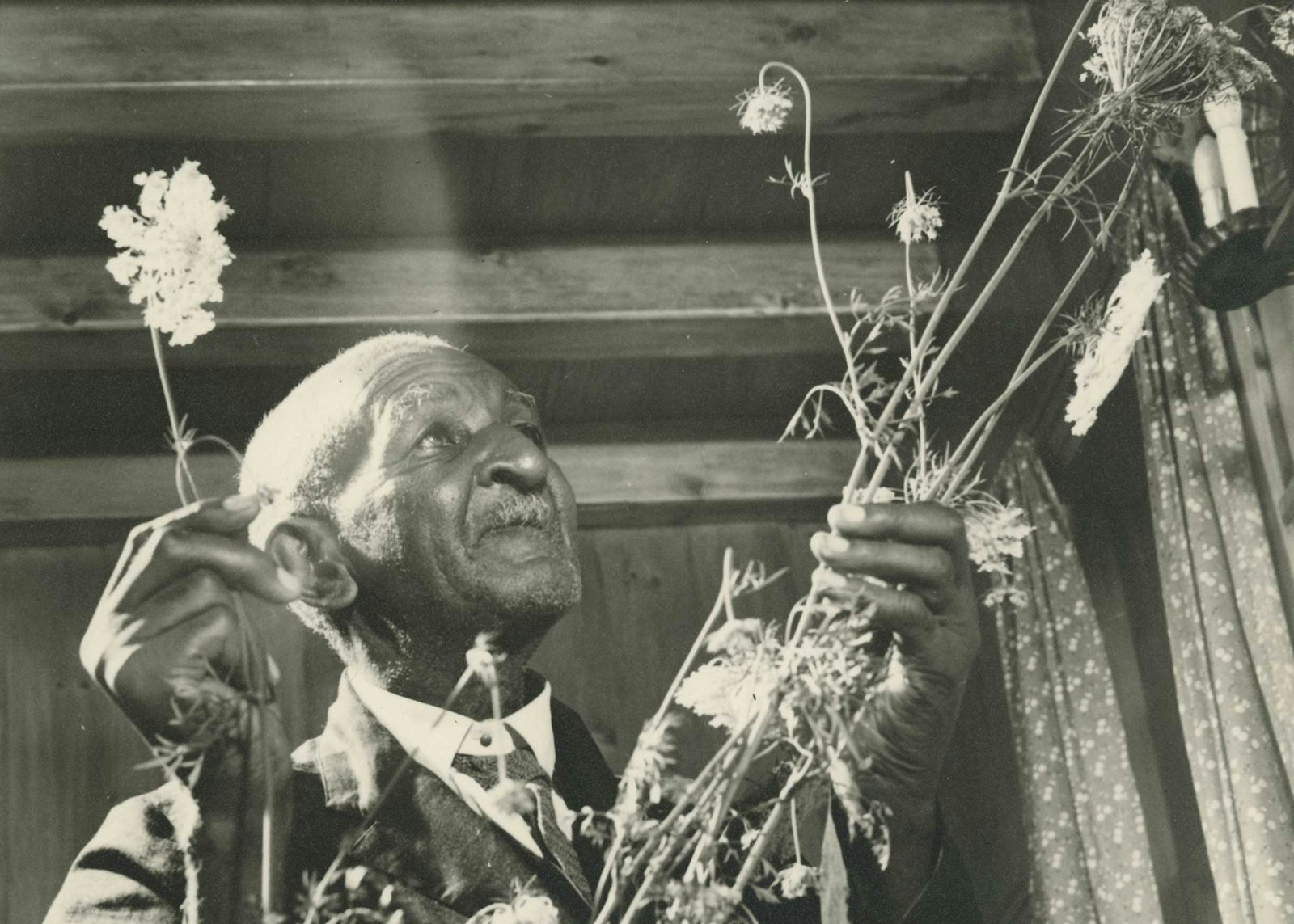
 George Washington Carver holding Queen Anne’s lace flowers, Greenfield Village, Michigan, 1942. Image from the collections of The Henry Ford.
Peanuts, Purples, and the Importance of Dyes
During the First World War, Germany ceased production of aniline dyes. Imports of these increasingly important chemicals into the United States began declining in 1914 and ceased altogether in 1916. Industries relying on dyes for printing, paint, papermaking, textiles, and leather were running short. Lacking capacity and chemicals for making aniline dyes in the United States, industry had to rely on natural dyes to fill the gap. The US government asked for Carver’s help. Carver searched the countryside for additional dye plants and located 28 plants from which he created 536 colorfast textile dyes. (See note 8)
But Carver knew that there were insufficient quantities of hedgerow plants for industrial use and that these natural dyes were often considered inferior to aniline dyes. We know from various sources that he was researching ways to make natural dyes more permanent. Although not specifically mentioned by Carver, it is interesting to note that creating aniline dyes using plants such as peanut skins as feedstock in the chemical process might be one way to improve colorfastness. In addition, a source of ammonium nitrate was needed to make aniline dyes. Ammonium nitrate was critical to the war effort as a key component in the manufacture of munitions, fertilizers, and dyes. The United States had been importing nitrate minerals from South America, but Germany set up a blockade, so the US government constructed a nitrogen plant (nee note 9) to make ammonium nitrate from nitrogen in the air.
A test run produced the first ammonium nitrate on November 25, 1918. Because Carver was interested in ammonium nitrate for both fertilizer and dyes, he was sent samples to begin experimenting with. However, with the end of the war, the plant ceased operation in January 1919. With no materials forthcoming, Carver turned his attention to other projects. George Washington Carver was filled with curiosity about the natural world. As he followed this curiosity where it led, he laid groundwork in many fields for generations of future scientists. We might not have Carver’s dye recipes today, but we can carry his curiosity forward and look to nature for color.
Notes
- For a discussion of slavery in southwest Missouri, see Diane L. Krahe and Theodore Catton, Walking in Credence: An Administrative History of George Washington Carver National Monument (National Park Service, 2014), 21–23.
- Rackham Holt, George Washington Carver: An American Biography (New York City: Doubleday, 1950), 9–10.
- Holt, George Washington Carver: An American Biography, 14.
- Gary Kremer, ed., George Washington Carver: In His Own Words (Columbia: University of Missouri Press, 1987), 50.
- Also known as A Grammatical Institute of the English Language, Vol. 1 and later, The American Spelling Book by Noah Webster.
- Kremer, George Washington Carver: In His Own Words, 20.
- The program was a success and became a model for the land-grant colleges’ Agricultural Extension Programs.
- Holt, George Washington Carver: An American Biography, 236-237.
- United States Nitrate Plant No. 2 at Muscle Shoals, Alabama.
- Eulanda A. Sanders and Chanmi Hwang, “George Washington Carver: Textile Artist,” Textile Society of America Symposium Proceedings (2014): 911.
Resources
This article originally appeared in Spin Off Spring 2022.