Watch our newest free braid lesson, then take your fractal spinning to the next level to create complex and interesting colors.
Watch our newest free braid lesson, then take your fractal spinning to the next level to create complex and interesting colors. <a href="https://spinoffmagazine.com/skill-guide-fractal-spinning/">Continue reading.</a>
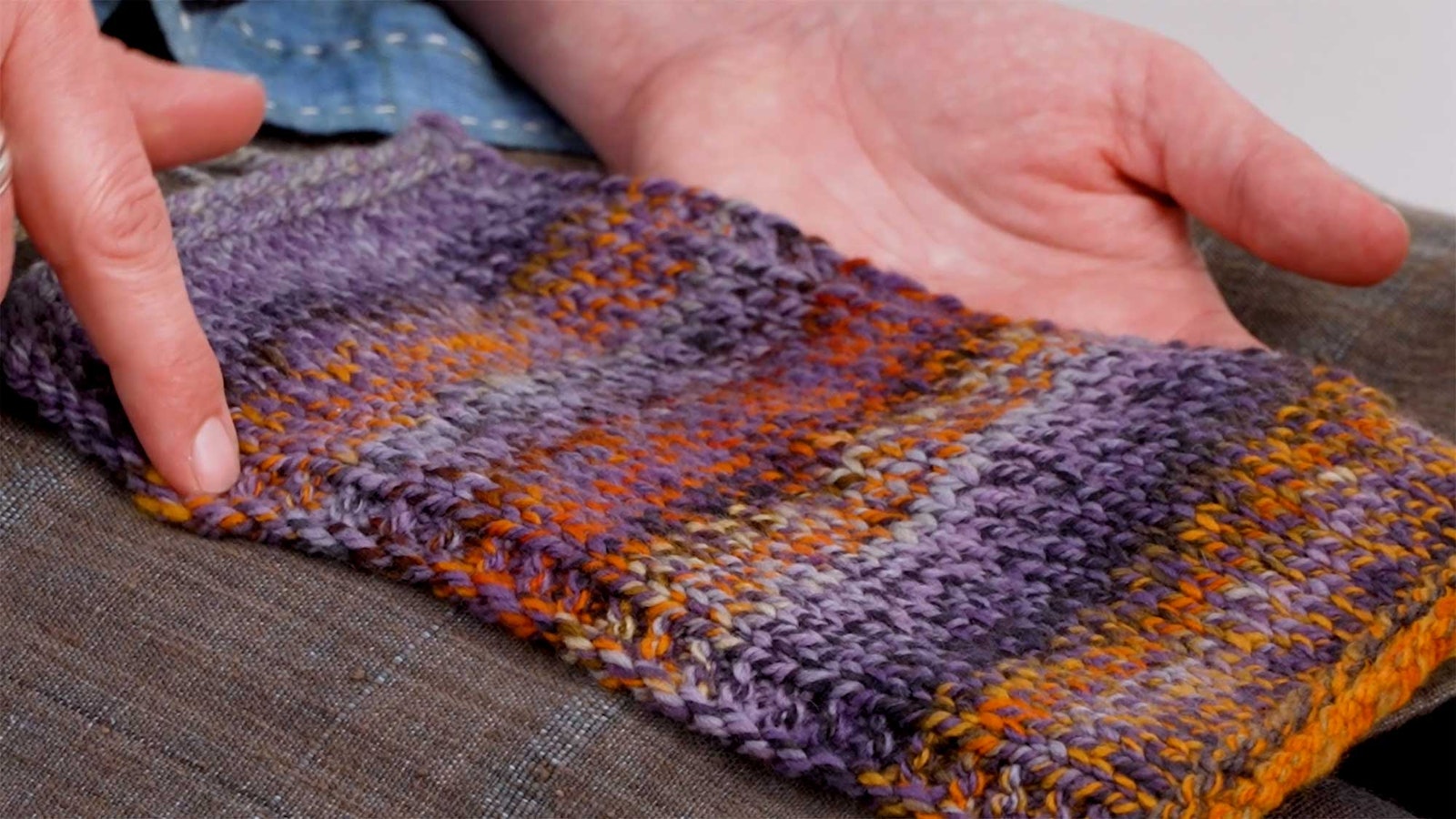
In the third lesson of 5 Ways to Prep and Spin a Braid with Kate Larson, we’re exploring fractals. Fractals are never-ending patterns that repeat at different scales. In everyday life, they can often be seen in branching and spiral patterns such as trees, river networks, the shape of our lungs, and even galaxies. Fractals are simple but stunning, and fractal spinning is no different!
To start, check out this quick video, where Kate Larson walks us through how to spin a three-ply fractal yarn.
Exclusive Skill Guide: Play with Fractals
Fractal spinning is a method for managing color in multicolored dyed top or roving. It applies the idea of repeating patterns at different scales to handspun yarn, combining the different scales in the plies for subtly layered stripes. In this skill guide, we’ll walk through the basics of fractal spinning and then dive deeper to discover more ways to play with fractals.
Color is complex, but there are a few simple guidelines that can help you plan your fractal stripe projects.
Scale
The first aspect to notice is the scale of the color repeats in the dye job. Here are some questions to ask about your roving that can affect the outcome.
SUBSCRIBER EXCLUSIVE
Unlock the Full Article with a Spin Off Subscription
Get instant access to this article and the entire Spin Off library of projects, inspiration, and expert instruction. With your subscription, you'll receive:
Master the art and science of spinning—from wheel mechanics to fiber prep
Learn from experienced spinners, dyers, and fiber artists in every issue
Explore in-depth tutorials, inspiring projects, and trusted techniques
Includes full access to print and digital issues of Spin Off Magazine
Spin Off explores the art and craft of making yarn. Each issue connects you to new and familiar voices in the handspinning community and is packed with information about fibers, tools, and traditions to inspire your creativity.
In the third lesson of 5 Ways to Prep and Spin a Braid with Kate Larson, we’re exploring fractals. Fractals are never-ending patterns that repeat at different scales. In everyday life, they can often be seen in branching and spiral patterns such as trees, river networks, the shape of our lungs, and even galaxies. Fractals are simple but stunning, and fractal spinning is no different!
To start, check out this quick video, where Kate Larson walks us through how to spin a three-ply fractal yarn.
Exclusive Skill Guide: Play with Fractals
Fractal spinning is a method for managing color in multicolored dyed top or roving. It applies the idea of repeating patterns at different scales to handspun yarn, combining the different scales in the plies for subtly layered stripes. In this skill guide, we’ll walk through the basics of fractal spinning and then dive deeper to discover more ways to play with fractals.
Color is complex, but there are a few simple guidelines that can help you plan your fractal stripe projects.
Scale
The first aspect to notice is the scale of the color repeats in the dye job. Here are some questions to ask about your roving that can affect the outcome. [PAYWALL]
Does your fiber have long or short stretches of color? This will determine the size of your stripes. It sounds obvious, but it is worth stating that a roving with short stretches of color will change colors more quickly than one with long stretches of color.
Are the relative scales of the colors even, or does one color have a longer stretch than the others? The answer will determine the overall tone of your finished yarn. In a roving where one color has a longer stretch than the others, the color with the long stretch will dominate your finished yarn. To verify this, take your roving and twist it together like a skein. Slightly squint your eyes to look at it and notice which color dominates.
Is the roving dyed evenly, and does each occurrence of color roughly match the size and intensity of other occurrences of the same color? The answer here determines the regularity of your stripes. If your roving is dyed fairly evenly and you spin it in a controlled manner, you can achieve even striping of your yarn.
In this braid, most of the color repeats are about the same length, but the orange is slightly longer and more visible.
Selecting Colors
Color is a large topic, but there are a few rules that we can discuss relative to the striping of space-dyed fiber.
More colors give more visually complex striping patterns. A roving with only two colors produces very clear striping patterns.
Analogous colors have more subtle striping effects than complements or triads.
Colors of the same value have more subtle striping effects than a combination of different values.
Bright hues tend to dominate when in equal proportion to tonal hues; light values tend to dominate when in equal proportion to dark values.
Five braids of spinning fiber. Braids dyed like the one in the center and the two on the right will give you more dramatic results. Photo by Pamela K. Schultz
How to Divide Fiber for Fractal Spinning
Divide your fiber lengthwise into equal parts for as many plies as you’d like to spin. If you’re spinning a two-ply fractal, you’ll split it into two parts. If you’re spinning a three-ply fractal, you’ll split it into thirds.
Set the first part aside. You’ll spin this for your first bobbin. Most spinners will split the second part into two sections—still splitting it lengthwise. This is sometimes called a 1:2 division. You’ll spin these two sections one after the other for your second bobbin to create the same pattern as the first, just on a smaller scale.
If you’re spinning a three-ply fractal, you’ll continue by splitting the third section into three parts lengthwise for your third ply—called a 1:3 division. Again, it’s keeping the original color sequence of the original braid, but at a smaller scale.
In theory, you can make as many plies as you like, and divide the fiber for each ply into as many sections as you want. In practice, though, you’re limited by the thickness of your combed top or roving—remember that your final yarn will never be thicker than the sections you split the fiber into!
If a four-ounce braid isn’t enough for the project you have in mind, consider scaling up your fractal spin with one braid per ply. Not only does this make sure you have plenty of yarn for your project, but it also lets you choose to make more divisions in your fractal.
Fiber that has been divided for a three-ply fractal. Photo from 5 Ways to Prep and Spin a Braid with Kate Larson
Keeping Track of Your Color Repeats
With all these little fiber bundles, how do you keep track? You’ll first want to make note of the starting color. This may be based on your own color preferences, or if the fiber is easier to spin from one end or another. No matter what you choose, you’ll have the same starting color for each bobbin and each individual strip of fiber throughout your spin.
In her video above, Kate likes to bundle each fiber into a little nest with her starting color on the outside of the bundle.
In Spinning Fractal Yarns, Heavenly Bresser prefers to bundle her fibers with the starting color in the center. For the multi-strip bundles, she makes a very loose knot between each strip, then proceeds to wind all the strips for a ply into a single bundle. That way, she knows each bundle is for a separate ply, and all she has to do is pick up a bundle and start spinning.
Whatever method you choose, the main thing is to set up a system that’s easy for you to follow—or take good notes!
Tying a loose knot is an easy way to keep the smaller strips in the correct sequence. Photo from Spinning Fractal Yarns with Heavenly Bresser
Spin and Ply
It’s important to decide how thick or thin you want your singles, before you start dividing your fiber strips—remember that your singles will necessarily be thinner than the strips of fiber!
Most spinners choose to spin relatively smooth singles for their fractal yarn, as the magic of fractal spinning happens in the interaction of the colors in the plying. (But there’s nothing that says you have to do it that way!)
Once you've spun all your singles, then it’s time to ply. Again, most spinners choose a classic plying structure to show off the fractal stripes. When you’ve plied and skeined your yarn, wet-finish it with your preferred method.
Note how the colors change as you start to ply! Image from 5 Ways to Prep and Spin a Braid with Kate Larson
Beyond the Braid
Although fractal spinning is most often done with space-dyed top or roving, you’re only limited by your imagination! Here are two more options for playing with fractal spinning.
Preparing Fractal Batts
In Spinning Fractal Yarns, Heavenly Bresser shows how to create a fractal yarn from a batt with clear color stripes. You could do this method on a drumcarder or even a blending board.
For a two-ply fractal yarn, Heavenly splits the batt in half widthwise. Set aside one half for bobbin #1. Split the remaining in half width¬wise. The two smaller batts are ready for bobbin #2.
If you want to scale up your fractal spin, you could create more than one batt in the same color striping sequence, designating one batt for each bobbin.
A batt with clear color stripes is a good candidate for fractal spinning. Here, the batt has been divided in half widthwise. The first half is for bobbin #1. Then the second half is divided in half widthwise again, for bobbin #2. Photos by Heavenly Bresser
Fractals from Blended Tops
Adapted from “Fractal Stripes from Blended Tops” by Becks of Tiny Fibre Studio, first published in Spin Off Spring 2025.
Blended tops are created using solid-color dyed fibers that are blended in a machine known as a gill box, which combs the fibers to blend, straighten and align them. They are usually processed—or gilled—more than once, and each pass makes the fiber smoother and more aligned but also results in the colors being less and less distinct from each other.
Blended top from John Arbon Textiles. Photo by Becks of Tiny Fibre Studio
After the first gill, the component colors are clearly visible and could be separated by hand easily. By the second gill, the colors have become much more blended. You may also see this type of fiber referred to as “humbug.”
The problem with applying a traditional fractal spinning technique to blended tops is that the colors in blended tops run vertically, rather than horizontally as they do in most handpainted tops, so splitting them as you would for a standard fractal gives a very different result.
If you apply traditional fractal spinning principles to blended top, the results can be so subtle as to be almost unnoticeable. Photo by Becks of Tiny Fibre Studio
Instead of thinking about the act of splitting the fiber, we need to focus on what’s happening with the colors. In a fractal yarn, blocks of distinct colors appear in succession, and replicating this with blended tops requires some rearranging of the fiber. Just because the colors happen to be arranged in a particular way by the manufacturer doesn’t mean they have to be spun that way!
First, separate the fiber horizontally into two—one for each ply. Then strip the top vertically into its component color groups—magenta, cyan, yellow, and brown. The number of colors that can be separated is dependent on the colorway and your personal preference. The more colors there are, the shorter the repeats of each color will be in the finished yarn.
By separating the blended top into its component colors, Becks was able to create her take on a fractal spin. Photo by Becks of Tiny Fibre Studio
For the first ply of her revised fractal, Becks spun each color one after the other, creating long color repeats. She recommends keeping a note of the color order you use, as you’ll need it for subsequent plies.
In the second singles, Becks divided each color group in half horizontally and spun them in the same order as the first singles, repeating the pattern of color groups twice. Then she plied the singles together for her unique fractal yarn from blended top!
How did your fractal spin turn out? Share it with us at [email protected]!

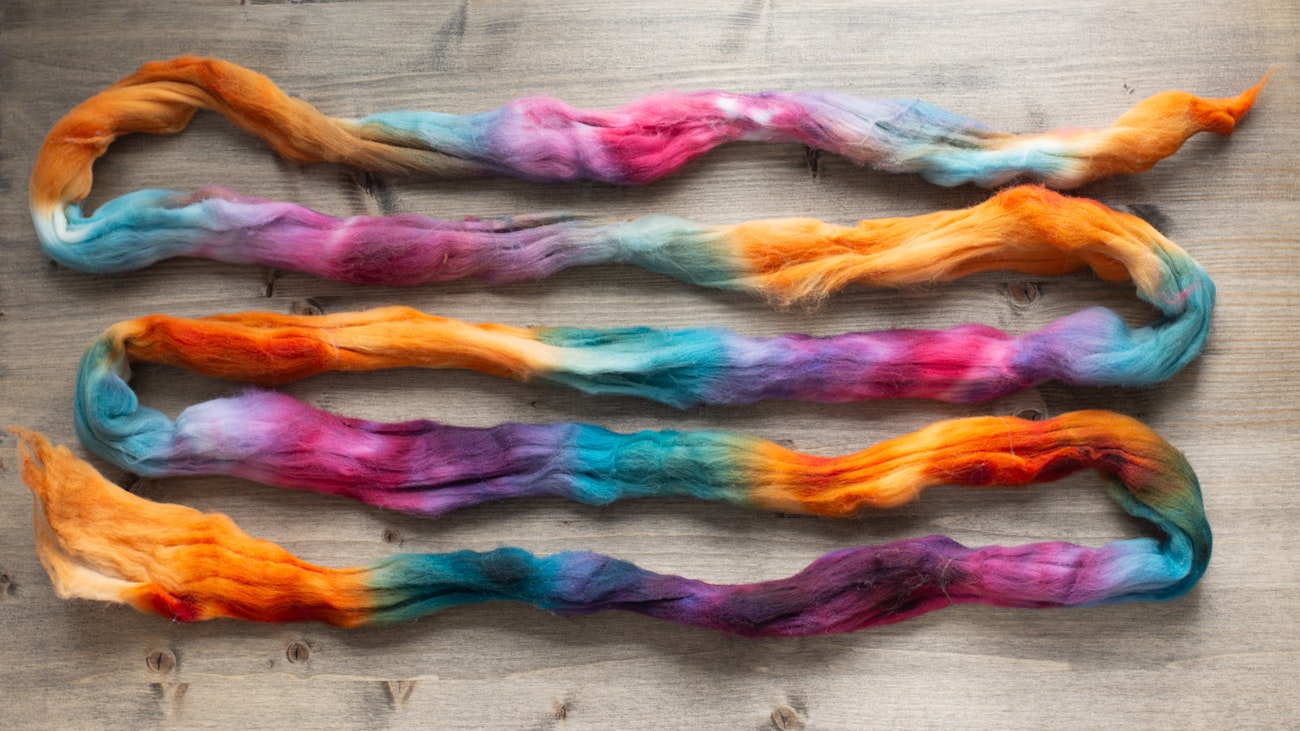 In this braid, most of the color repeats are about the same length, but the orange is slightly longer and more visible.
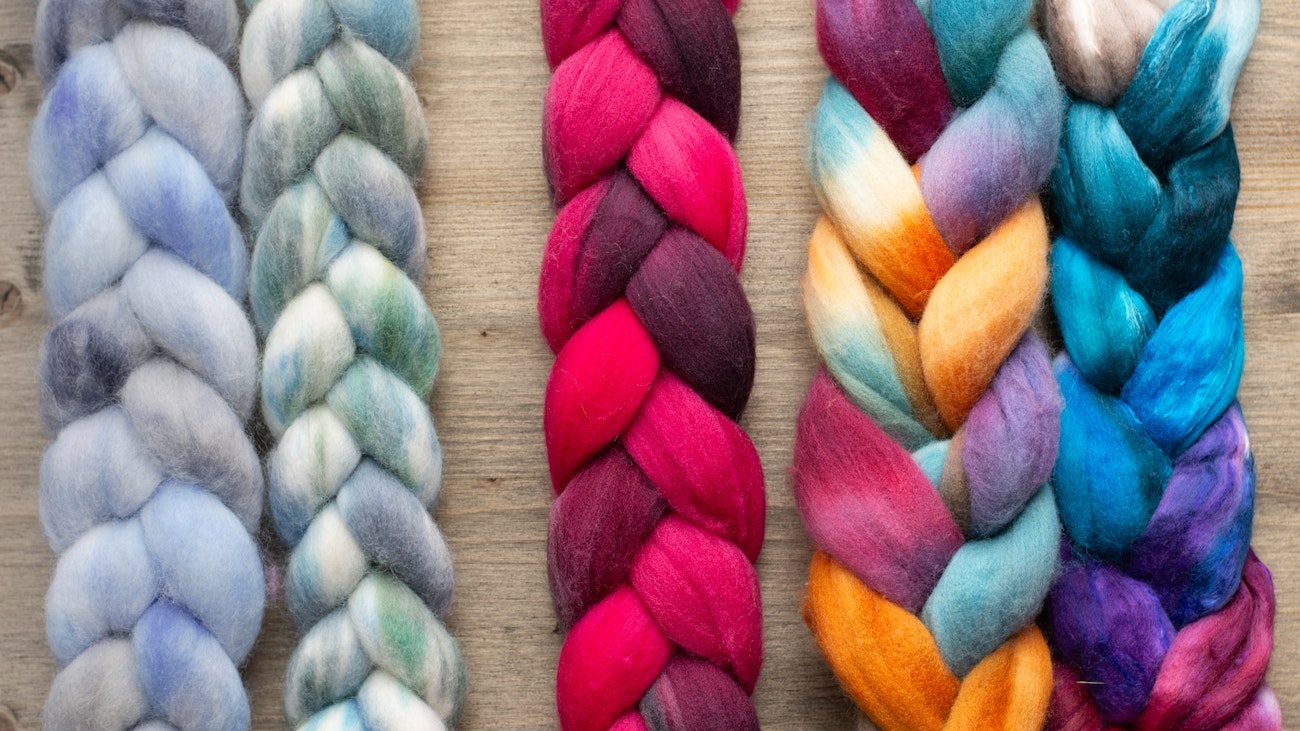 Five braids of spinning fiber. Braids dyed like the one in the center and the two on the right will give you more dramatic results. Photo by Pamela K. Schultz
 Fiber that has been divided for a three-ply fractal. Photo from 5 Ways to Prep and Spin a Braid with Kate Larson
 Tying a loose knot is an easy way to keep the smaller strips in the correct sequence. Photo from Spinning Fractal Yarns with Heavenly Bresser
  Note how the colors change as you start to ply! Image from 5 Ways to Prep and Spin a Braid with Kate Larson
 A batt with clear color stripes is a good candidate for fractal spinning. Here, the batt has been divided in half widthwise. The first half is for bobbin #1. Then the second half is divided in half widthwise again, for bobbin #2. Photos by Heavenly Bresser
 Blended top from John Arbon Textiles. Photo by Becks of Tiny Fibre Studio
 If you apply traditional fractal spinning principles to blended top, the results can be so subtle as to be almost unnoticeable. Photo by Becks of Tiny Fibre Studio
 By separating the blended top into its component colors, Becks was able to create her take on a fractal spin. Photo by Becks of Tiny Fibre Studio