Subscriber Exclusive
Spinning the Steppe: Camel Fiber and Firebox Spindles
Follow Heather’s process as she spins and knits a vest for her toddler to stay warm in the Mongolian winter.
Follow Heather’s process as she spins and knits a vest for her toddler to stay warm in the Mongolian winter. <a href="https://spinoffmagazine.com/spinning-the-steppe-camel-fiber-and-firebox-spindles/">Continue reading.</a>
https://spinoffmagazine.com/cdn-cgi/image/format=auto/https://www.datocms-assets.com/75073/1789581335-img_9480-maxson-so-win-2020-header-edited.jpeg?auto=format&w=900
Contents
January
There is a wind blowing across the Mongolian steppe, a bitter, dry wind that never seems to let up. All the polyester snowsuits and acrylic sweaters in the world can’t keep my baby warm.
Through the worst of the winter, I have kept him indoors, safely out of the wind, cradled or wrapped to me. But he is growing and seeking adventure. He wants to be on the cold ground learning to crawl. Soon, the lunar new year will come, and it will be time to adventure outdoors in the wild steppeland. Even then, there will be five or six more months of cold.
It is time for his mother to be resourceful.
I take out my fiber stash and look at what I have to work with: wool from local sheep, gathered with my children in summertime; a bit of coarse goat wool, collected from thorns and briars on the steppe; and perhaps half a kilogram of camel fiber.
SUBSCRIBER EXCLUSIVE
January
There is a wind blowing across the Mongolian steppe, a bitter, dry wind that never seems to let up. All the polyester snowsuits and acrylic sweaters in the world can’t keep my baby warm.
Through the worst of the winter, I have kept him indoors, safely out of the wind, cradled or wrapped to me. But he is growing and seeking adventure. He wants to be on the cold ground learning to crawl. Soon, the lunar new year will come, and it will be time to adventure outdoors in the wild steppeland. Even then, there will be five or six more months of cold.
It is time for his mother to be resourceful.
I take out my fiber stash and look at what I have to work with: wool from local sheep, gathered with my children in summertime; a bit of coarse goat wool, collected from thorns and briars on the steppe; and perhaps half a kilogram of camel fiber. [PAYWALL]
Folk wisdom tells us that the warmest of all fibers is camel down, the coat that keeps those great beasts warm through Siberian blizzards. It is not sheared; it falls from the camel each spring in great big clumps. These clumps are gathered and treasured by herding families. The coarse guard hairs are used to make the ropes and belts needed for the gers, or yurts, that many people live in. The softer down is used to make socks, scarves, and vests to keep out the winter chill.
Baby must have a camel-down vest, I decide. He hates the many layers I force him into whenever we venture outdoors. The vest will be different. It will allow him freedom of movement, but it will keep his core temperature stable.
In Mongolia, no enemy is feared as much as the cold. Nearly every sickness, from pneumonia to a sore throat, an upset stomach to the hiccups, is connected to being cold. To be warm is to be well, to be cared for, to be safe. With cold as the enemy, there is no better weapon to combat it than the wool of steppe animals. And there is no better fiber than the coat that falls from the camel’s back.
From Clumps to Clouds
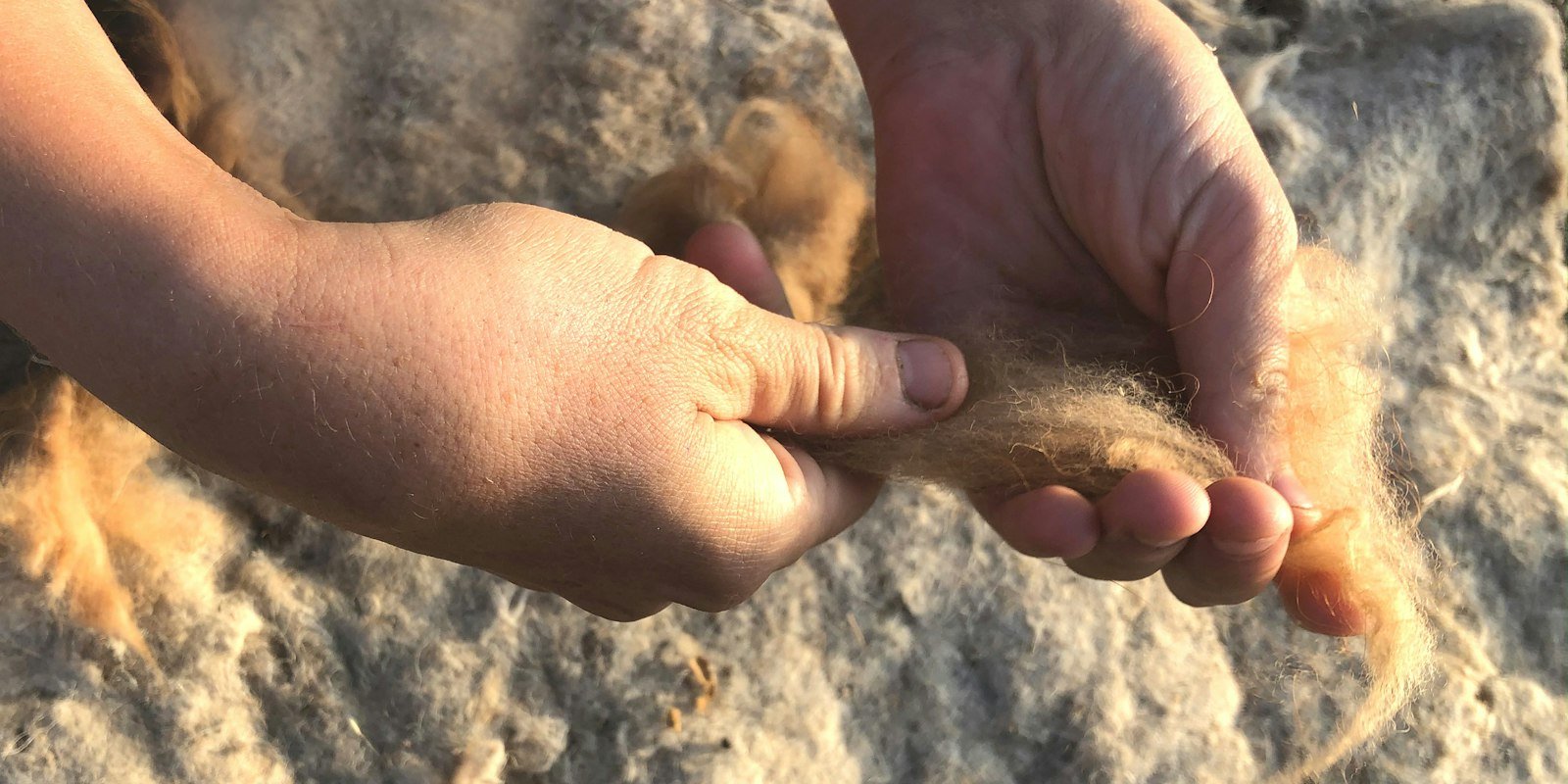
My camel fiber is still in the clumps that were gathered, and before I begin spinning, I must prepare it. We don’t have wool pickers or carders; no one here has seen such things. I prepare my fiber by hand the old way. It is slow going, but it is a peaceful, meditative work.
This basic and effective form of fiber preparation requires no tools beyond my own hands and is accomplished through repeated drafting. When finished, the resulting preparation is more organized than most carded cloud but has the loft and airiness of a traditional cloud preparation. This skill was taught to me by the old grandmother who also taught me to spin. As we sat together on the floor of her little mud house, she worked with the wool of a fat-tailed sheep, and she spun on a simple drop spindle with a rough metal whorl.
Whenever I use this preparation method, pulling apart my fibers and watching the matted clumps turn into soft, organized clouds, I think of her old, wrinkled hands, the hands that gave me this knowledge and skill. To her, spinning had always been a necessity—something as natural as breathing, as simple as eating food. But her own children and grandchildren had not cared to learn, and she was glad to teach me, even though I was an outsider.
 Camel fiber is collected and saved.
From Clouds to Yarn
My roving is ready now, and I bring it to the wheel, sit down, and let my foot find its place on the wellworn treadle. My wheel is a beautiful old Saxony from Holland, many thousands of kilometers away.
A month ago, she came to me in pieces with no instructions and a broken leg. My children helped me put her together; the first few tries were wrong, but with persistence, we discovered all her secrets. My husband took the broken leg pieces and made a new leg to fit, and it was a grand day when she was finally standing independently and ready to sing. Camel fiber for baby mittens was the first project spun on her. When the mittens were finished, I was ready to begin the vest.
When spinning my hand-prepared camel down, I like to use a basic short draw. The first bobbin fills with singles; I change to another. I love the song of my spinning wheel, and I love to watch her work. Right now, the soft camel brown is the most beautiful color to me. When two bobbins are full, I ply and fill two more bobbins with two-ply yarn. These two skeins will be the beginning of the vest.
 Spinning hand-prepared camel
February
After a wash in warm water and drying on the heater, I begin to crochet. I start by following a pattern but end up changing it to meet my needs: I want it to be
long and able to fit over layers, and I want it to fit for a long time.
 Plied camel yarn
Halfway through the front panel, I run out of handspun. Nearly six more bobbins must be spun before my baby will have his vest. So I go back to my favorite seat in the house—the stool placed at the wheel—and again I spin. Sometimes baby is on my lap while I spin, and other days, he plays near me.
He is not always a model of contentment, however, and there are days when I can’t find quiet time to use the wheel. He gets sick, and there are long evenings when I pace the house with a feverish baby wrapped to my chest. During those times, I use the cross-arm
spindle I made during a winter afternoon not long ago.
March
I continue spinning camel down on both my cross-arm spindle and spinning wheel. As each skein is plied, I use a crochet hook to add it to my work in progress. When the two panels are done, I use a length of handspun to sew them together. Finally, it is time to put the vest on my child.
I meant to wash and block it immediately when it was finished, but first, I tried it on baby to be sure it fit.
The fit was perfect and so exactly what he needed to be wearing right then that I couldn’t take it off. It was nearly a week before I managed to wash it, and then he
needed it as soon as it was dry.
 Baby is ready for the steppe
May
It is May now, a cold, windy day at our steppeland home, but baby will no longer be homebound. Outside is the grand and glorious sky. What is more, there are five wild puppies, two big dogs, and endless flocks of cashmere goats, fat-tailed sheep, cows, yaks, and horses in the open range beyond our home. He must go out, and I put the little vest on him and set him out by the door. As he toddles where he will, he is protected from the cold, and while his brothers play nearby, nothing will hurt him.
 One of Hannah’s handmade spindles in the Mongolian Steppe
Resources
This article originally appeared in the Winter 2020 issue of Spin Off.