Subscriber Exclusive
What Is Organic Cotton?
<a href="https://spinoffmagazine.com/what-is-organic-cotton/">Continue reading.</a>
https://spinoffmagazine.com/cdn-cgi/image/format=auto/https://www.datocms-assets.com/75073/1777578969-260211_sosum26-130-organic-cotton-ffk-sum-26-mg.jpg?auto=format&w=900
Textile labels describing an item as “organic cotton” attempt to do a few different things: describe the way something was made, help create markets for organic materials, and provide consumer assurance. But what does “organic cotton” actually mean?
At their most basic, organic certifications address either agricultural or manufacturing
practices. This means that, broadly speaking, “organic” has pre- and postharvest meanings. “Organically grown cotton” and “organic cotton” are actually two very different things.
For example, the oft-seen GOTS (Global Organic Textile Standard) label means that an item is made of at least 70% certified organic natural fiber, and the fiber itself is certified to its relevant, government-controlled organic standard. The European Union, China, and the United States each have their own organic standards. There are differences not only within each set of standards, but also in how the standards are enforced, associated labor practices, and more (see note 1).
Many people handle and monitor cotton fibers as they travel from the field to our knitting needles. The major players in all of this are producers (farmers and manufacturers), organizations that create the certification standards (governments and private organizations), and inspectors (the people on the ground who examine cotton fields or factories for certification).
SUBSCRIBER EXCLUSIVE
Textile labels describing an item as “organic cotton” attempt to do a few different things: describe the way something was made, help create markets for organic materials, and provide consumer assurance. But what does “organic cotton” actually mean?
At their most basic, organic certifications address either agricultural or manufacturing
practices. This means that, broadly speaking, “organic” has pre- and postharvest meanings. “Organically grown cotton” and “organic cotton” are actually two very different things.
For example, the oft-seen GOTS (Global Organic Textile Standard) label means that an item is made of at least 70% certified organic natural fiber, and the fiber itself is certified to its relevant, government-controlled organic standard. The European Union, China, and the United States each have their own organic standards. There are differences not only within each set of standards, but also in how the standards are enforced, associated labor practices, and more (see note 1).
Many people handle and monitor cotton fibers as they travel from the field to our knitting needles. The major players in all of this are producers (farmers and manufacturers), organizations that create the certification standards (governments and private organizations), and inspectors (the people on the ground who examine cotton fields or factories for certification).
[PAYWALL]
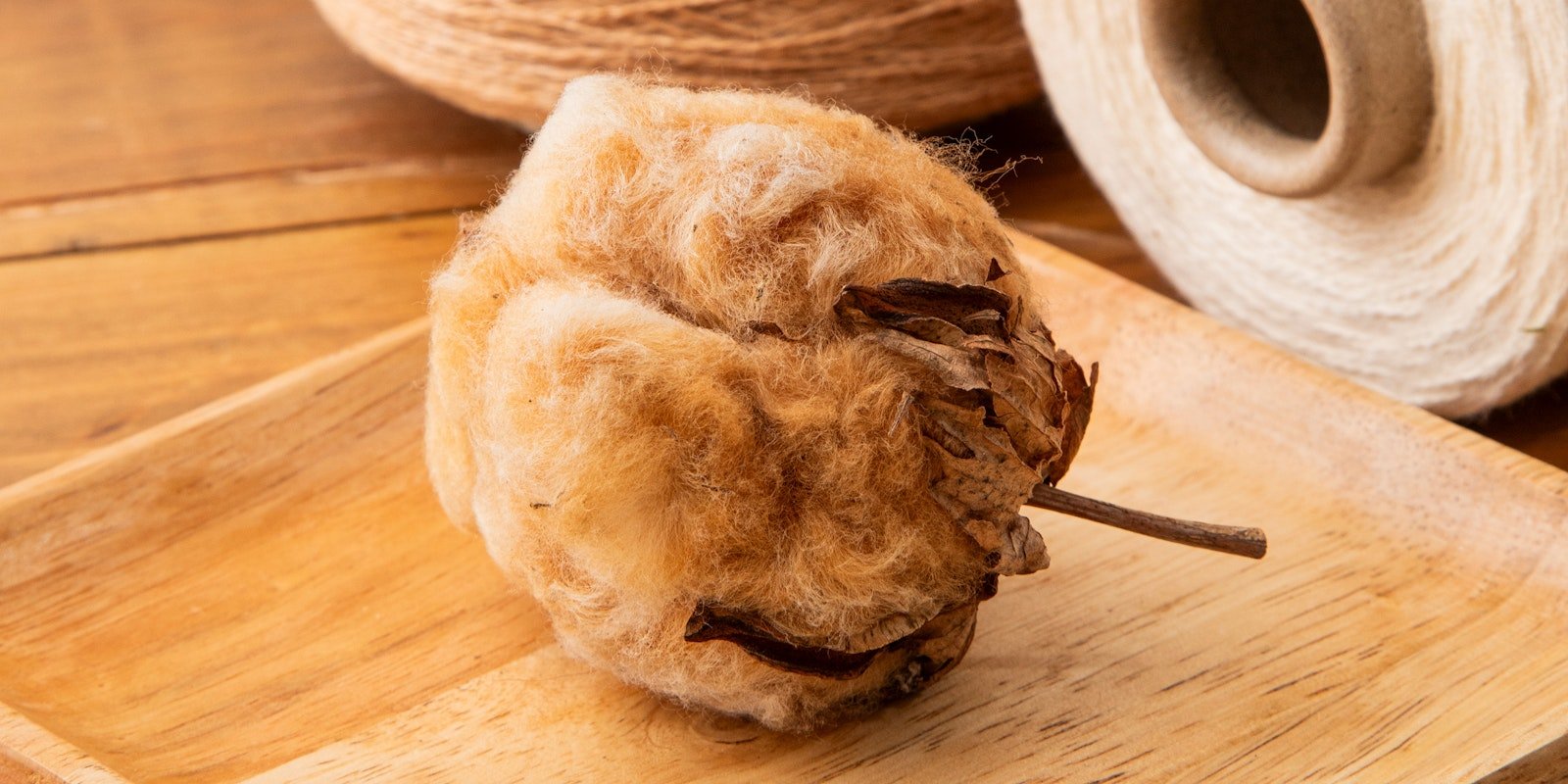
 Sally Fox’s organic brown cotton (left) and a conventionally grown cotton boll (right). While fiber color is due to genetics, not growing conditions, most conventionally grown cotton is white.
Why Organic?
“Ecological and pesticide concerns drove the creation of early ‘organically grown cotton,” says Sally Fox, an organic cotton breeder and farmer with over 40 years of experience. Fox bred the first types of environmentally friendly colored cotton that could be spun into thread on a machine, and she wrote the first organic textile standard for Texas, signed into law by Director of Agriculture Rick Perry, who would go on to become governor. “I studied entomology and pest management to reduce pesticide misuse by being a scientist. Pheromones are the way insects communicate with each other. Understanding and using insect pheromones is fundamental to organic practices, to manage pests in a less toxic way,” Fox explains.
These standards either limit or altogether prohibit synthetic pesticide application, preventing the use of hundreds of chemicals and encouraging methods such as mechanical weeding instead. The USDA standards cover soil fertility methods—such as the use of compost, crop rotation, and rest—and untreated and non-GMO seeds. Cotton traceability,
handling, and storage are included, too. Bales can be tracked to the farms by name,
and warehouses store organically and conventionally grown cotton separately, to prevent cross contamination.
Cotton seeds matter, too, as they and the plants they grow into can be more or less pest resistant depending on genetics. “I got into colored cotton because a USDA cotton breeder was giving out brown cotton seeds,” Fox adds. “Brown cottons were supposed to be innately resistant to pests, and breeders could incorporate that. There is a lot more to it, of course, like soil fertility, but not having to deal with pests is worth trying.” Seeds are also part of building systems of mutual support. “Organic cotton seeds are a primary component in organic dairy, because organic cotton seed is a feedstuff, Fox says. “When I gin my cotton, the seeds get sold to organic dairies, which saves costs for both of us. That mutual support ethos shows the wisdom of the original ‘organic’ founders.”
 The Furrow Scarf is an easy crescent shawl that allows you to relax and enjoy beautiful yarns. From top: Blue Sky Fibers Organic Cotton Sport, Appalachian Baby US Organic Cotton Sport, and Vreseis Foxfibre 10/2. Find the pattern in Farm & Fiber Knits Summer 2026.
Organic Processing
If the bales of raw organic cotton continue into processing and manufacturing steps that also adhere to organic standards, there are many additional considerations: storage and transportation, prohibited and permitted fibers for blending, and the use of safer and organic dyes. Organic manufacturing standards either restrict or wholly ban potentially damaging chemicals including BPA, PFAS compounds, microplastics, and chemicals identified by the United Nations as hazardous (see note 3).
The GOTS documentation includes restrictions on the use of ammonia and bleaching in wet
processing, as well as in detergents, residues, and finishing treatments. You’ll even find prohibitions on single-use, nonrecycled plastic hangers. There is a lot to navigate, and there are inspectors on the ground at many of these stages, monitoring practices against documented standards and filling out a lot of verification forms. When asked about inspections at the field level, Fox says,“Many inspectors are or were farmers, good people who know how hard it is.”
The More you Know
The standards themselves are worth reading (and are actually quite readable), and the Textile Exchange, OEKO-TEX, and GOTS standards all cover organic cotton (see Resources). If you care deeply about farm and land practices, organically grown standards may be of interest for further reading. Search for the organically grown certification documents from various governments, especially for the major cotton-producing countries noted earlier in this article.
These days, it is tempting to assume labels are fairly meaningless, but some labels do matter and are worth understanding and supporting. “It’s great that someone starting out in knitting or spinning today has all these choices of organic cotton, whether affordable or something more storied,” Fox says.
Notes
- Global Organic Textile Standard (GOTS), “Organic Fibres.” global-standard.org/the-standard/gots-key-features/organic-fibres.
- Foreign Agricultural Service, US Department of Agriculture, “Production—Cotton,” fas.usda.gov/data/production/2631000.
- United Nations Economic Commission for Europe (UNECE), "About the GHS," unece.org/about-ghs.
Resources
This article originally appeared in the Summer 2026 issue of Farm & Fiber Knits.