
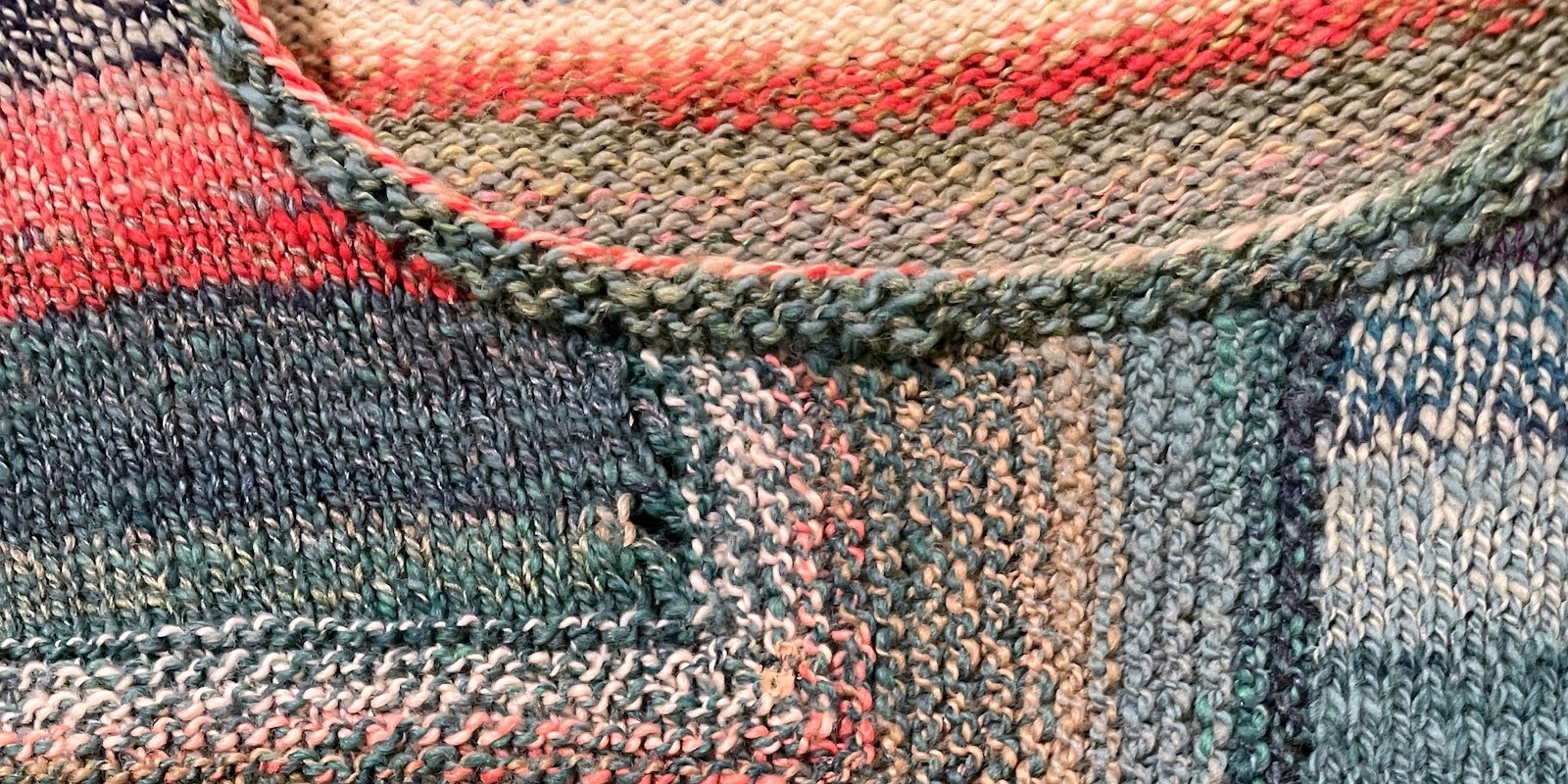
Pattern and designer Tetris Pullover by Julia Farwell-Clay.
Fiber Handpainted braids in Bluefaced Leicester (BFL), BFL/silk, Merino, and Merino/Cashmere.
Wheel system Lendrum, double treadle, scotch tension.
Ratio 8:1.
Drafting method Worsted with short-forward draw.
Singles direction Z-twist.
Singles wraps per inch 29.
Ply wraps per inch 14–18.
Total yardage 1,969 yards.
Yards per pound 1,060.
Yarn classification/weight DK.
Yardage used 1,300 yards (includes about 120 yards for sampling).
Needles Size 6 (4 mm), size 7 (4.5 mm), and size 6 (4 mm) 16" circular.
Gauge 20 sts × 30 rows = 4".
Finished size 44".
 Teresa in her finished Tetris Pullover. Photo by Jason Young
I have been spinning off and on for about 25 years. I watched a woman demonstrating spinning at an old settler’s cabin at the YMCA of the Rockies, and I knew I wanted to spin. At that time, I was a single parent pursuing a degree and had no time for hobbies. After I graduated, I took classes with Maggie Casey and many others at Shuttles, Spindles and Skeins, her yarn shop in Boulder, Colorado. I learned to knit and crochet as a child from my grandmother, but I didn’t keep it up. After I took up spinning, I realized I needed to do something with the yarn I was accumulating and revived my knitting. When I first learned to spin, I spun a variety of fibers but in small amounts. I’ve knitted scarves and hats using my handspun, but I wanted to spin enough to knit a sweater. I have a bit of a fiber stash, but I don’t want to waste it—I feel I need to spin with a purpose in mind. I don’t spin fast; I love the tactile feel of the fiber drafting through my fingers and find the whole process to be very relaxing.
Inspiration
The main inspiration for this project was Debbie Held’s article “Coordinating Handpaints” in Spin Off Winter 2017. I was taken with the idea of randomly combining my stash to spin a large amount of yarn. I love color, and I couldn’t see myself spinning 2 pounds of the same monotonous color. I was also inspired by Yarnitecture by Jillian Moreno. I took a class from Jillian several years ago and had chosen several of the projects in the book that I wanted to create. I wanted to spin enough yarn to knit a sweater, and her book made this first sweater easier. I also thought a multicolored yarn would show off the pattern designs in the Tetris Sweater.
 Teresa started with a variety of braids from her stash.
I have been collecting my stash for many years. I tend to buy Merino, Bluefaced Leicester, and some silk or other more exotic fibers in blends. According to the “Coordinating Handpaints” article, any colors and fibers will work—no matter how different from one another—but I had my doubts. A lot of my choices were similar, but I threw in a few outliers and was very pleased with the look of my first sample. When spinning my first sample, I realized that switching from braid to braid (and fiber to fiber) was going to be a challenge to spin consistently, so I took the time to predraft all the fiber.
The Challenge
The most challenging part was the sample process and getting the correct grist and a worsted-spun, DK-weight yarn—my default yarn is more woolen. But seeing all those colors come together as singles and then plied to make the yarn was my favorite part of the process. I was afraid to start for fear I would mess it up but have let go of my younger self’s tendencies toward perfectionism. I want my yarn to look handspun, not machine-made.
 Some of Teresa’s sample yarns and fibers.
I’m so proud of my sweater and have worn it every day during the frigid Colorado winter. Sometimes it is too warm, but when it’s below freezing outside, it’s perfect! I love it when someone comments on it so I can say, “I spun the singles, plied that into yarn, and knitted this sweater—it all started with piles of colored wool.”
Have a finished object to share? Tell us about it! Contact [email protected] to submit your project.
Resources
- Read Deborah Held’s original article, “Coordinating Handpaints”.
- Get 5 Tips for Choosing Combo Spinning Fiber.