Subscriber Exclusive
Choosing Your Fiber Prep: When to Card, Comb, or Flick,
When it comes to fiber prep, you’ve got options! Find out what to look for to make the best choice for you and your fiber.
When it comes to fiber prep, you’ve got options! Find out what to look for to make the best choice for you and your fiber. <a href="https://spinoffmagazine.com/choosing-your-fiber-prep-when-to-card-comb-or-flick/">Continue reading.</a>
https://spinoffmagazine.com/cdn-cgi/image/format=auto/https://www.datocms-assets.com/75073/1788198625-graves-locks-header.jpg?auto=format&w=900
Contents
Wool locks, with their sometimes ringlet-like curls, are beautiful but sometimes confounding in terms of their processing. Spinners may worry that choose the “wrong” tool or application and ruin a perfectly great batch of locks, but there’s no singular right or wrong way to process them for spinning. Your options are plenty and include combing, carding, flicking, spinning from the lock or clouds.
Knowing which method or tool to choose can feel overwhelming when first working with fleece in this natural form. The good news is that any “rules” in dealing with locks are merely guidelines—there’s rarely a single best way of processing a particular type of fleece for spinning.
SUBSCRIBER EXCLUSIVE
Wool locks, with their sometimes ringlet-like curls, are beautiful but sometimes confounding in terms of their processing. Spinners may worry that choose the “wrong” tool or application and ruin a perfectly great batch of locks, but there’s no singular right or wrong way to process them for spinning. Your options are plenty and include combing, carding, flicking, spinning from the lock or clouds.
Knowing which method or tool to choose can feel overwhelming when first working with fleece in this natural form. The good news is that any “rules” in dealing with locks are merely guidelines—there’s rarely a single best way of processing a particular type of fleece for spinning. [PAYWALL]
Start Fresh
Regardless of the tool and technique you choose, always ensure that your locks are well-scoured and grease-free to protect your tools and make your spinning easier and more consistent. Grease, dirt, and lanolin can shorten the life span of your equipment, and their buildup is difficult to remove.
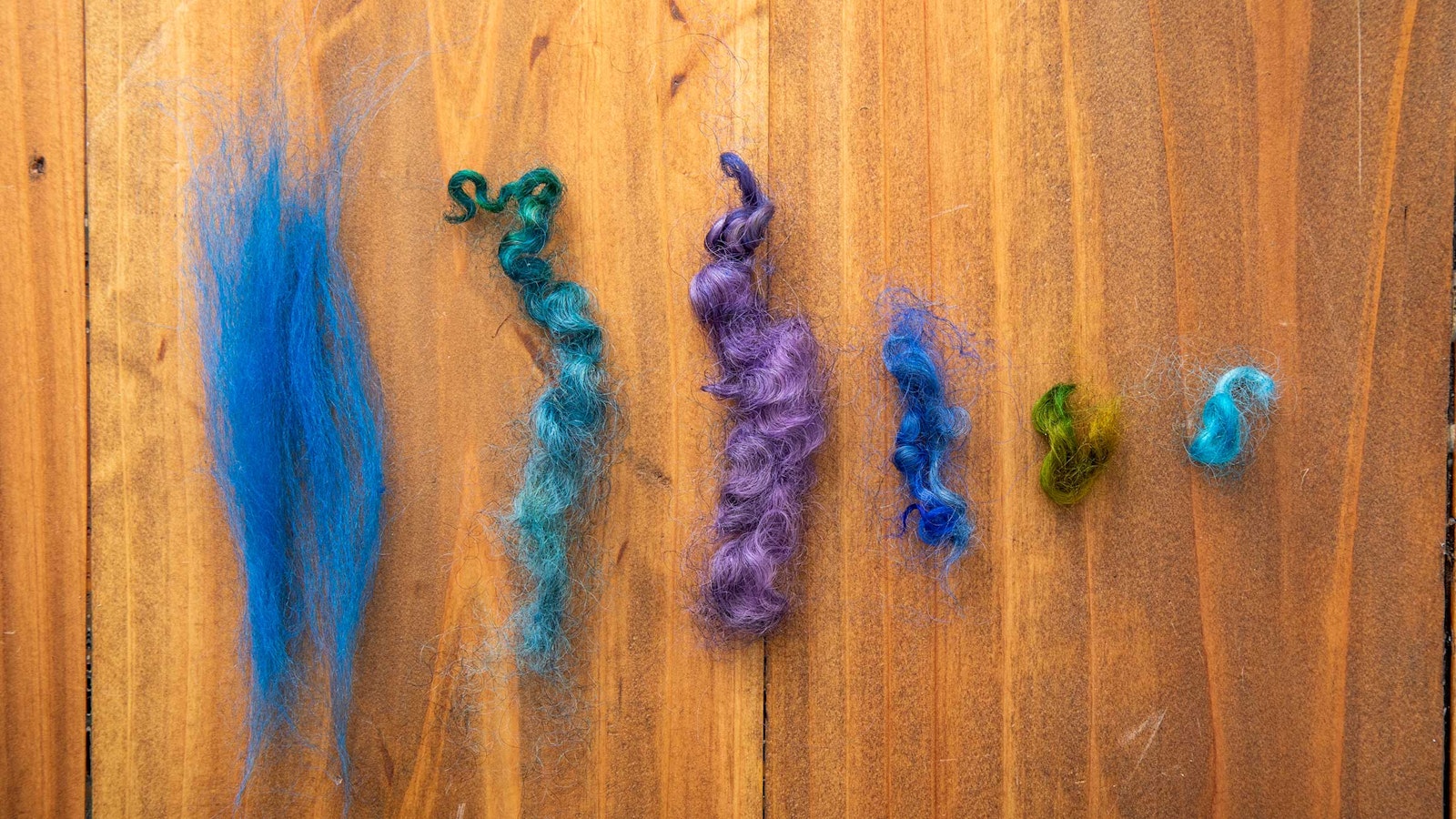
 An array of luscious locks, each unique. Photos by Deborah Held unless otherwise noted
Consider What You Have on Hand
Some tools are adaptable beyond their expected uses, including hand cards. While known for their ability to card open strands of fiber for fluffy, easy spinning and the loftiest of yarns, a set of hand cards can also be used for flicking open one or both ends of a lock (aka flick-carding), making the lock both airy and easily spinnable while maintaining its staple formation. This same tool is also good for flick-combing, or mimicking the job of hand combs.
Of all the at-home tools available to the handspinner for processing locks, many say that a set of hand cards are the most versatile. My own most-used tool for working with fleece and locks is the blending board, which I approach similarly to hand cards for surprising results, such as fully woolen, disorganized carded clouds made from shorter to medium (2-4") staple length locks.
If you’ve yet to acquire any such tools at all, your hands are useful for hand-picking, or pulling locks open width wise.
 Wavy, 3–4" Corriedale locks yield differing results when combed and dizzed (front) vs. carded and dizzed (rear). Both are perfectly usable—and gorgeous.
Consider Your Fiber
Sheep fleeces and the locks they provide us grow in all sorts of variations—sometimes within one flock or even on a single sheep. Locks might be crimpy, wavy, curly, and anywhere in between. They come in all lengths—again depending on the breed—and general guidelines for processing break down into a few easy starting points.
The first step in deciding on the tool to choose for prepping your fiber is to look at its makeup. Pull out a clean lock and examine it. Are the strands smooth and shiny, or is the exterior thick and fuzzy? These are elements you may wish to accentuate in the spun yarn.
 1–1.5" yearling New Zealand Corriedale (right) and yearling Rambouillet with second cuts (left). Debbie would card the Rambouillet due to its jumbled and varied lengths, all less than one inch long. The Corriedale could be prepared in more ways, though Debbie likes flicking it due to its combination of traits.
Next, consider the patterning and whether the fiber is crimpy, wavy, curly, or somewhere in between. Fiber with lots of crimp tends to bounce back into place once extended, meaning that it has good memory for projects like socks, while fiber with sheen generally has more drape. Gently pull from both ends at the same time to further evaluate the lock’s response.
Third, check your lock’s length from end to end. Staple length is another good starting point when considering the tool to pair with your fiber, though again, suggested guidelines for working with particular lock lengths are just that and may or may not work well for your intended yarn (see below for more information). Finally, consider the end project you have in mind for this fiber, or at least the type of yarn you’d like to spin and the traits you’d like to highlight.
Note: If your fiber contains a significant amount of VM, or vegetable matter, do not use your carding equipment in the hopes of the equipment removing this debris. Not only will the results be disappointing, the debris will further embed itself in between the strands of fiber as they’re carded open, furthering the problem. Concurrently, these bits of hay and veg matter will now be down in your carding cloth, waiting to catch a ride on any future carding materials.
 Debbie would only comb this silken, 5"-plus long blue Teeswater, as one of our few definitive prep tool and fiber matches. As for its neighbor, washed-in- alingment 4.5" brown Charolais, it, too had a more certain future with a set of hand combs. However, flick-combing or even flick-carding could also be beautiful as a way to slightly lessen the fiber’s dense toothiness.
Quick-Start Guide
Now that you’ve looked at all the factors, here’s my quick-start guide to choosing when to card, comb, or flick your locks.
When to consider carding
- You’re working with locks that are about 3 inches or less. (Many spinners still have excellent results carding locks up to 5", though these longer strands spin best when dizzed off the carding tool or spun directly from the open locks.)
- The locks have a toothy, bouncy crimp pattern or a coarser, unsmooth appearance.
- You want to spin a fuzzy and/or airy yarn.
When to consider combing
- You’re working with longer locks. (You may comb shorter locks, but do be careful of creating a too-dense result.)
- You’d like to maximize their shiny exterior and/or emphasize drape.
- The fiber is more curly or wavy than crimpy.
When to flick (card or comb)
- You’d like to spin directly from the open-ended lock.
- You have an “in-between” type of fleece or you’d like to spin an in-between style of yarn.
- You don’t have combs or a hackle, but you’d like to spin in a more worsted manner by flick-combing first.
- Your only prep equipment is a flicker brush.
Other Considerations
- Sampling more than one combination of preparation and spinning draw is always recommended
- A diz may be added to carded or combed locks to create a roving or sliver, respectively
- Two or more processing tools may be used in one spin, such as combing to remove short bits of fiber followed by carding to introduce loft
Conclusion
The best approach to working iwth locks depends on the traits you’d like to highlight and tools you have to help you do so. Be sure to sample your fiber before committing to any technique. Any of the above tools and methods may be used in tandem, one after the next, or alone. So long as your finished yarn meets your crochet, knitting, or weaving requirements, you’ve chosen wisely!
Resources