
Contents
In the upcoming Fall 2026 issue of Spin Off, Rowena Zuercher shares her adventures in making spindles with scrap wood from her own backyard. She carefully considered the different properties of the woods available to her, and explored what made a good whorl. Get this sneak peek at Fall 2026, and try your own hand at scrap pile spindles and distaves!
—Spin Off editors
After I finished my spindle experiment with scrap wood and hardware store whorls for Spin Off Fall 2026, I wanted to push my carving skills a little further. I still had plenty of wood, so I decided to make two distaves (one handheld, one supported by the body) and two whorl-less spindles (one dealgan-inspired, one supported).
Making a Dealgan
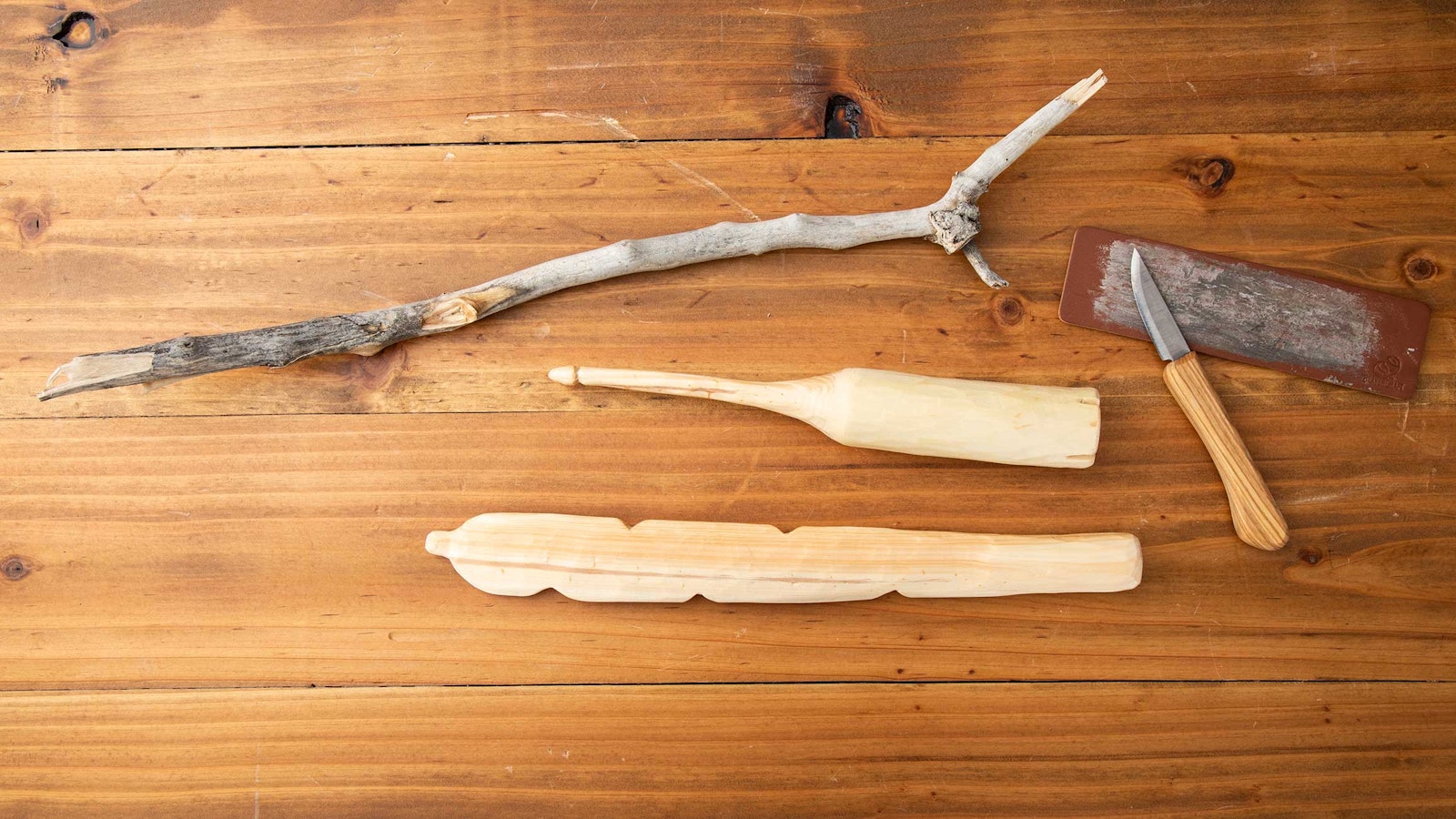
For the dealgan-inspired spindle, I started with a stripped pine branch 1.5" in diameter and 11" long. In pencil, I marked the shaping I had planned for the body, and roughed out that form with my larger knife. I used the detail knife to carve the notch at the top of the spindle and the grooves for the yarn at the bottom. I lightly sanded the spindle when I was happy with my work. I didn’t want to sand the body perfectly smooth, as I enjoyed the handcrafted look of my whittling grooves.
I’m very happy with the spin of this spindle! It works just as well as a dealgan I purchased some years ago which surprised me. This spindle took me about three hours to make.
 Rowena started with a pine branch stripped of its bark to make her dealgan-inspired spindle. Photos by Rowena Zuercher unless otherwise noted
Making a Supported Spindle
For the supported spindle, I used white cedar gifted from my grandpa and split the plank in half, ending up with a piece of wood that was ¾" tall, 1" wide, and 11" long. I wanted to use the full width and height of the wood for a built-in whorl portion near the bottom of the spindle. The rest of the plank I planned to whittle down to a thin spindle shaft. Again, I marked out the shaping with a pencil and used my larger knife to rough out the design. I finished up with my detail knife, and lightly sanded the spindle. Unfortunately, it didn’t have much of a spin. The wood was so lightweight that the built-in whorl didn’t make much of a difference. The spindle needed more weight at the bottom.
I drilled several holes in the whorl, and then used 80 grit sandpaper to sand out the holes until I had one large hole through the center of the whorl. For the weight, I used two small hardware nuts. I wedged them into place and secured them with a few drops of super glue. This spindle took me about four hours in total to make, and while it does technically work, it won’t be the first spindle I reach for when I want to spin.
 Rowena’s supported spindle with a weighted whorl.
Making Distaves
The two distaves are both pine from the scrap wood in my yard. The long branch was too curved to cut and carve into spindles, but its natural bend seemed like a good fit for supporting in a belt against my body. I stripped the branch smooth, then whittled two notches in the top to secure a ribbon around my fiber. It is 23" tall with a circumference of 2.75". I’ve used this distaff a little bit, but it’s fiddly to position comfortably in a belt. I think that says more about my lack of experience with a tall distaff than the distaff itself. This was about a three-hour project.
The second distaff is a handheld distaff, 14" tall, and 1.5" across the paddle. I started with a rather large pine branch that I cut to have a flat surface and a round handle. This involved removing a lot of excess wood, so I used a small hand axe to rough out the shape. I refined the surface and details with my whittling knives, cutting notches into the sides to help the fiber hold onto the distaff. This was a four-to-five-hour project, and since finishing, I have used this distaff regularly.
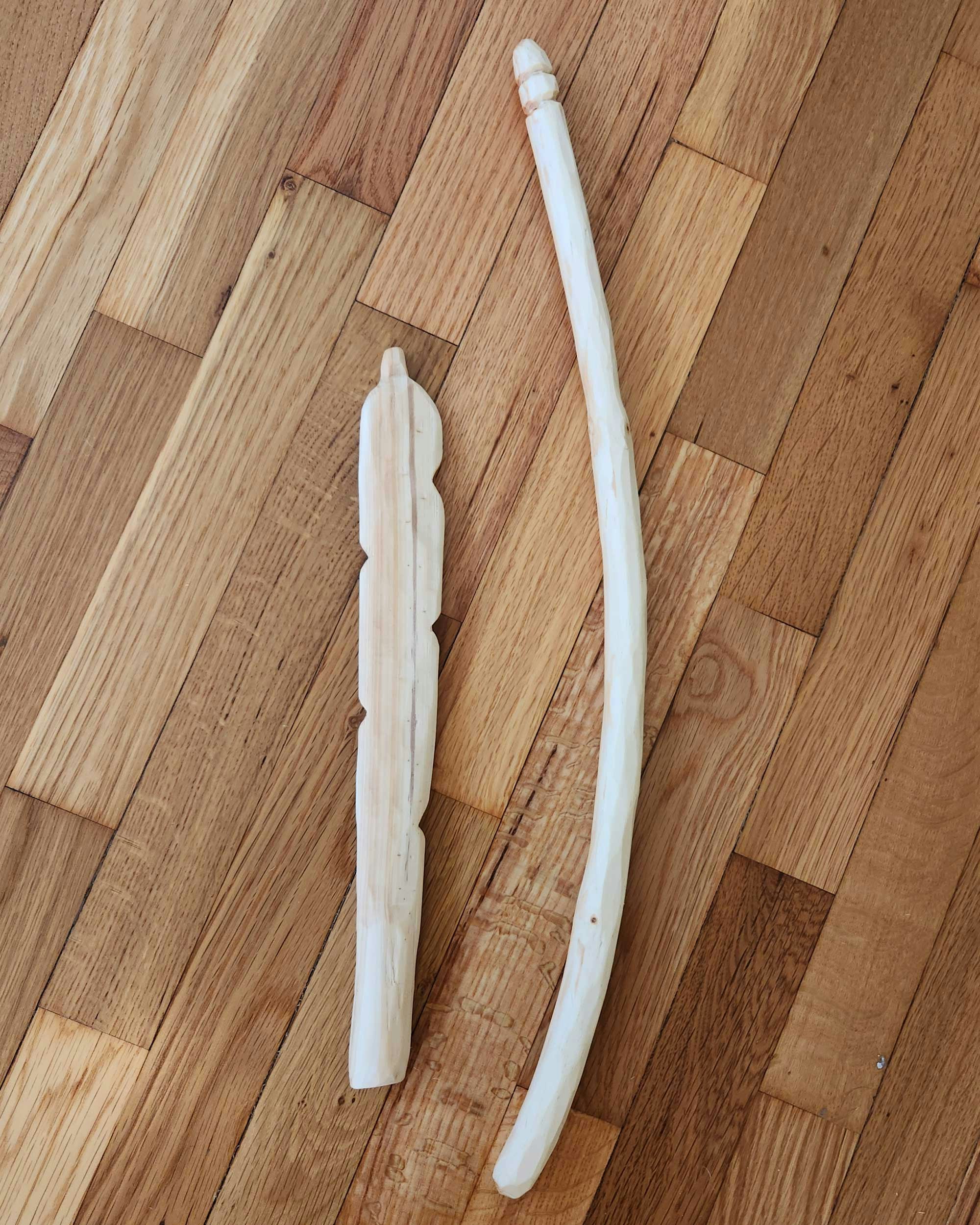
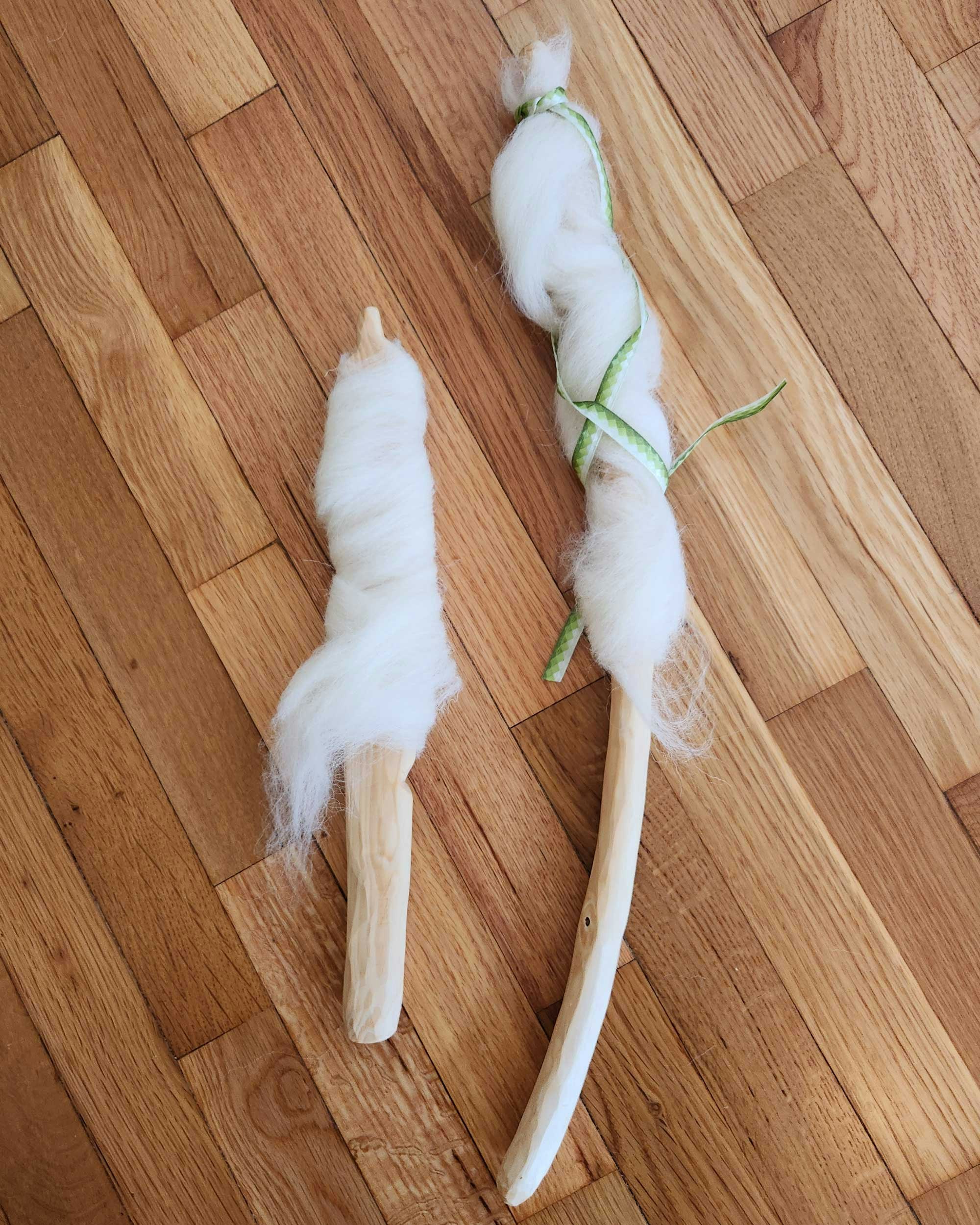
Rowena’s curved and paddle distaves with and without fiber.
Lessons Learned
These four whittling projects pushed my abilities, tried my patience, and taught me a lot about the behavior of wood. I have a deep respect and appreciation for master wood carvers and turners who craft perfectly balanced spindles. There is a lot more that goes into the physics of a spin and the refinement of a spindle than I first realized. I look forward to learning more in the future, and would encourage anyone who has thought about making their own spinning tools to dive right in!
 Rowena used a small hand axe,whittling knives, a handheld saw, and sandpaper to make her spindles and distaves.
Resources
- Learn more about dealgan spindles.
- Don’t miss out on the rest of Rowena’s woodworking adventures—subscribe to Spin Off today!